Yesterday evening at the Fondation Louis Vuitton in Paris, Alexandre Hazemann and Victor Monnin were named winners of the second Louis Vuitton Watch Prize for Independent Creatives. The award carries a €150,000 scholarship and a year-long mentorship at La Fabrique du Temps Louis Vuitton. It follows Raúl Pagès and his RP1 Régulateur à Détente, which took the inaugural prize in 2024. It is also the second major recognition for the duo, who won the F.P. Journe Young Talent Competition in 2023 with an earlier iteration of the very same watch.
That watch, the Montre École—School Watch—is the real story here. And it deserves scrutiny on its own terms, independent of the trophy.
What the Watch Actually Does
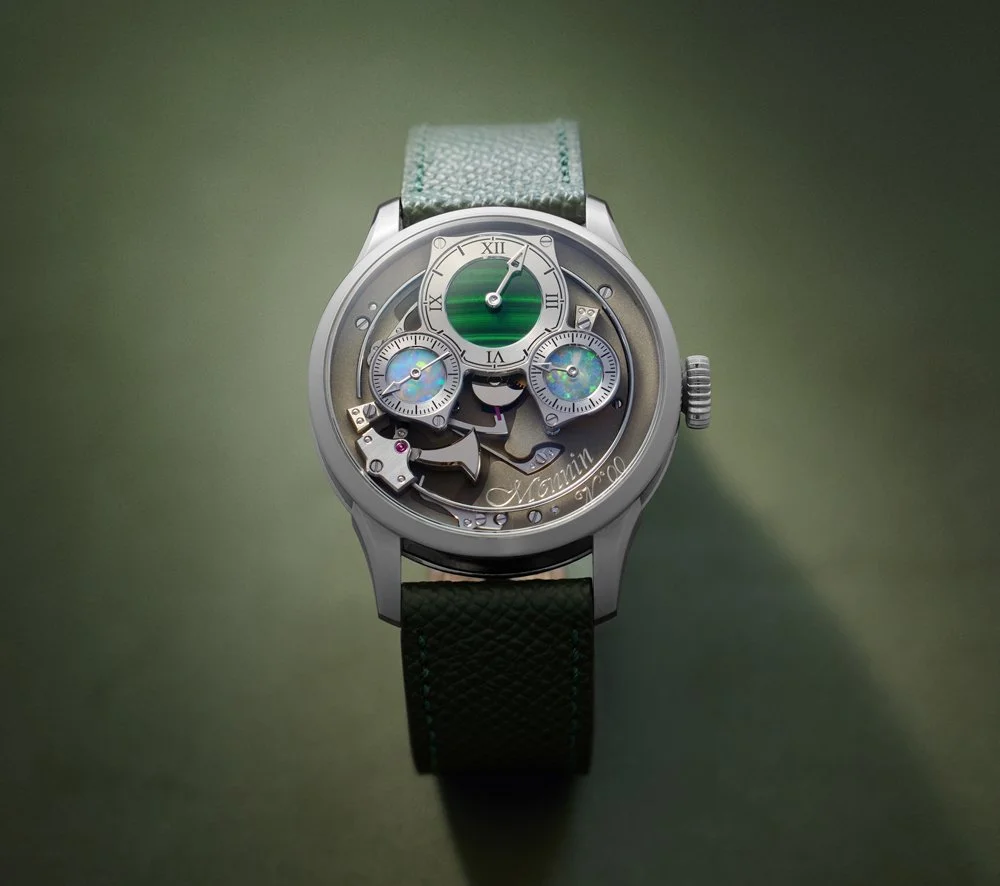
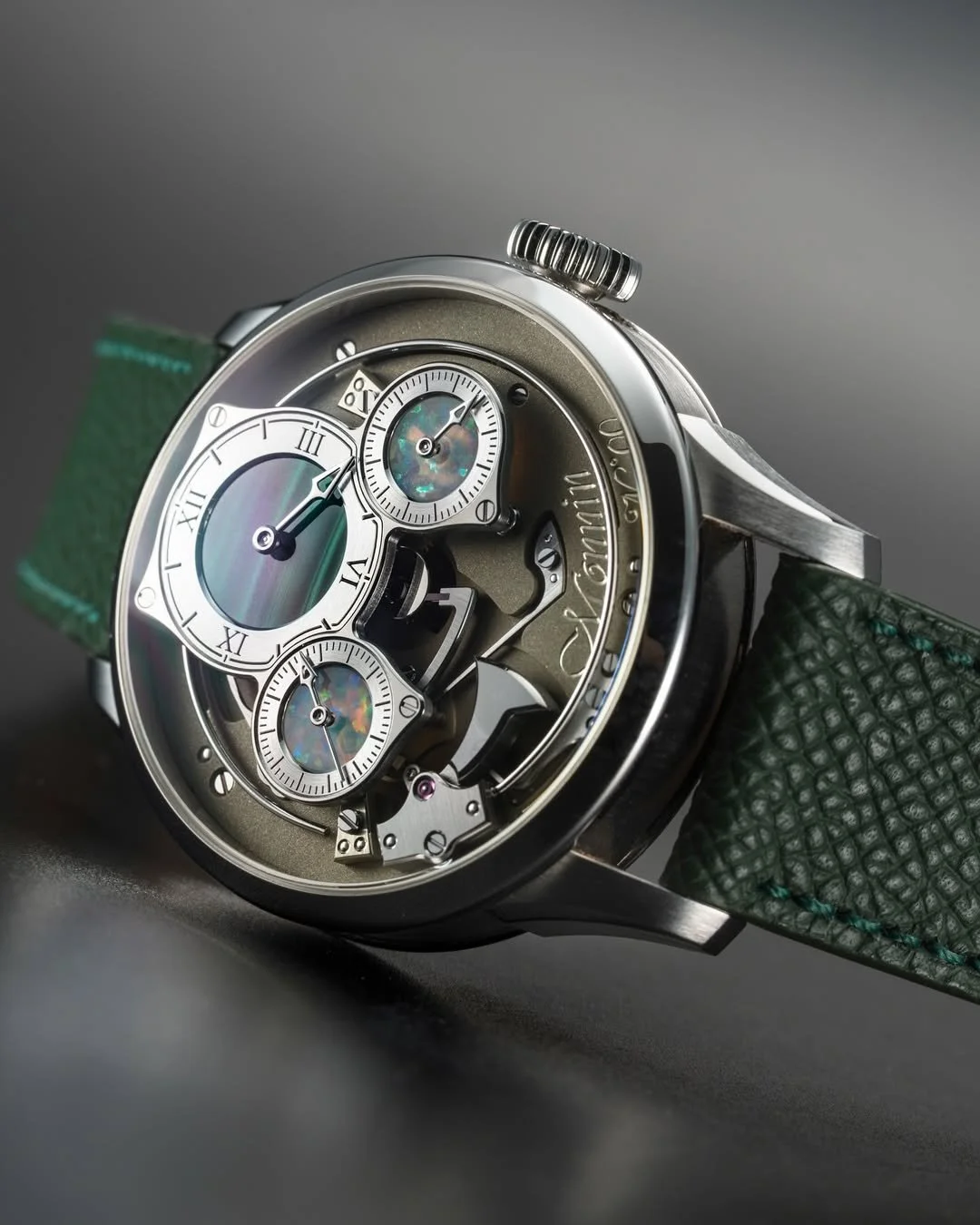
The 10-piece limited edition Hazemann & Monnin School Watch pairs two complications that rarely coexist in a 39.5 mm steel case: an instantaneous jumping hour and a sonnerie au passage—a striking mechanism that chimes autonomously at the top of each hour. Both functions are driven by a single snail cam at the centre of the movement, which accumulates energy over sixty minutes. As the feeler of the grande bascule lever—tipped with a ruby to reduce friction—falls off the snail's edge, one arm advances the twelve-tooth hour wheel at 12 o'clock while another lifts the hammer to strike the gong. The entire sequence occurs simultaneously, visible through the dial side.
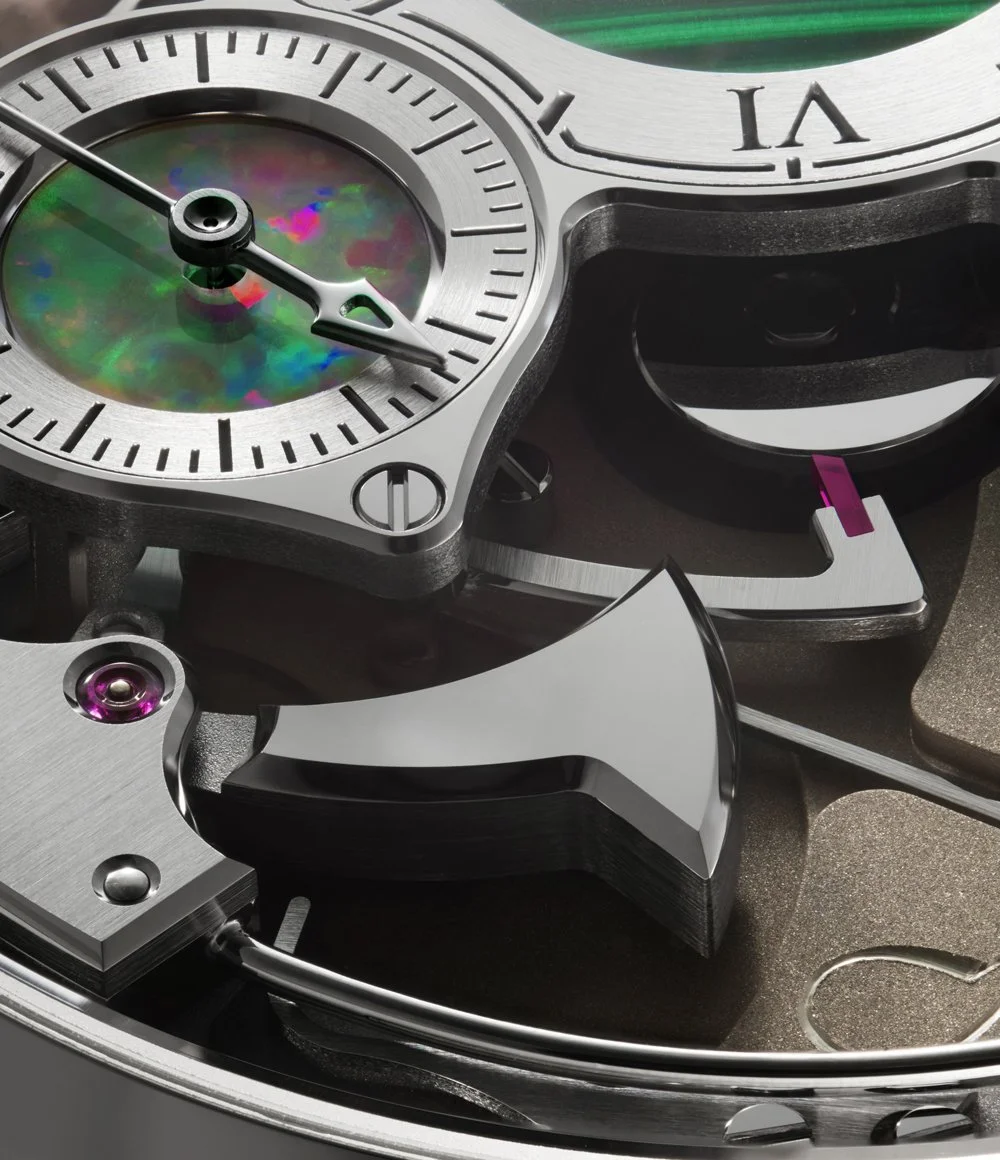
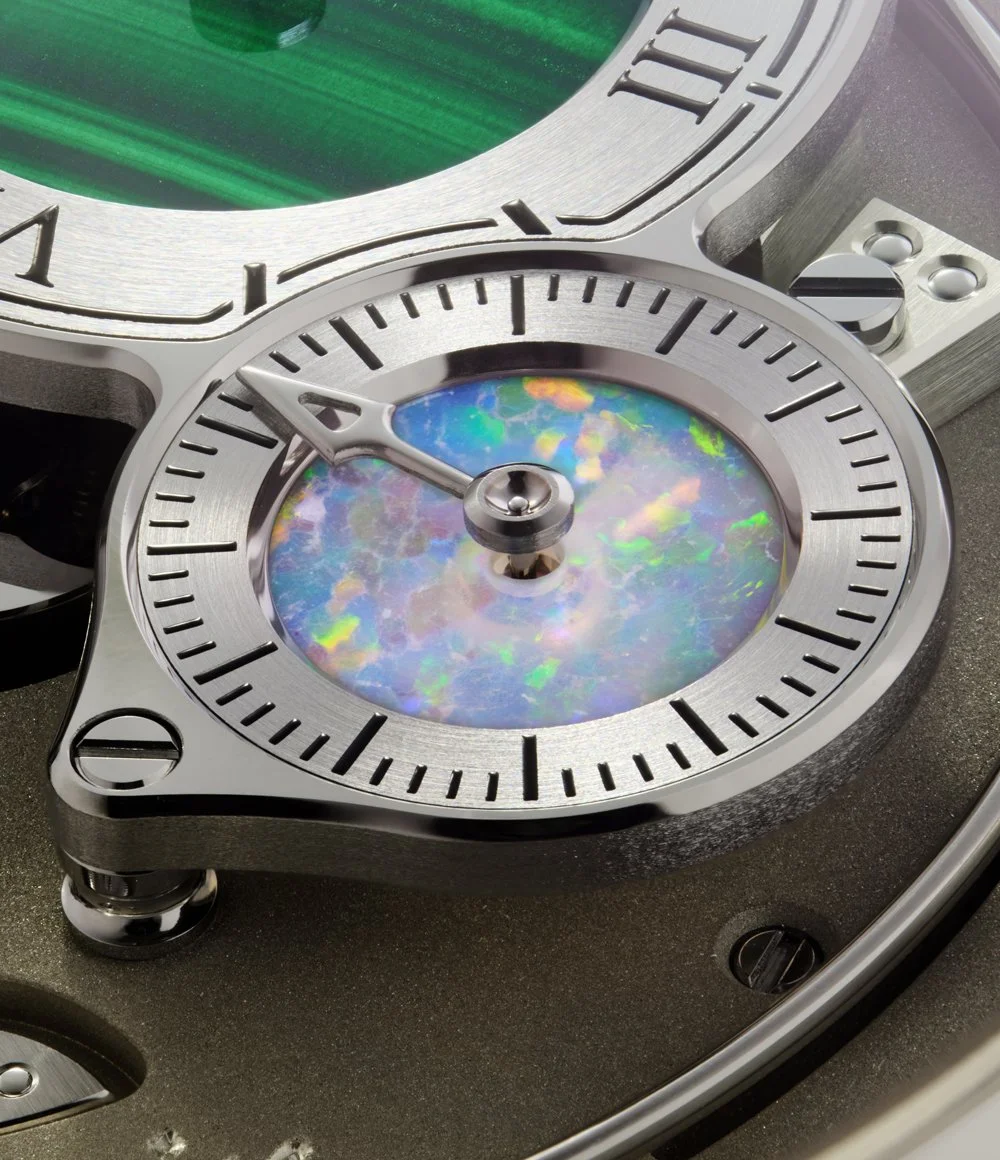
This is not a minute repeater. It does not strike on demand. It strikes in passing, a complication with deep roots in pocket watchmaking and clock-tower horology, but one that remains exceptionally rare in a modern wristwatch. The distinction matters: a sonnerie au passage must function reliably hour after hour without user intervention, which imposes different engineering constraints than a repeater activated by a slide or pusher. The energy management is continuous, not episodic. To make the watch even more relevant, the openworked dial is graced with a malachite hour dial and two opal subdials for the minutes and running seconds.
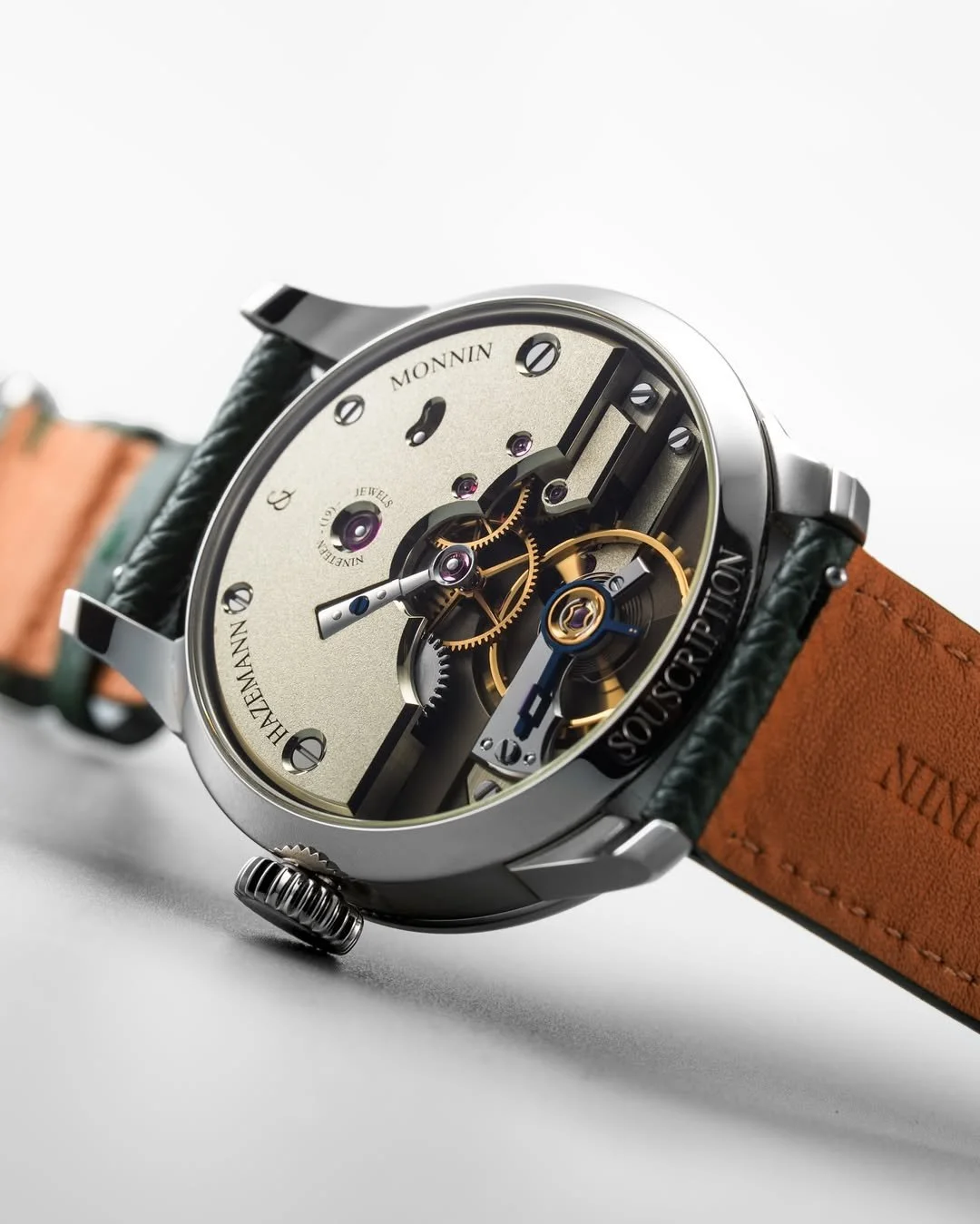
The manual-wound movement powering this watch is the calibre HM01, which is entirely designed in-house. The original school watch was built on a La Joux-Perret 6900 base; the production version shares nothing with it. Architecture is vertically aligned with the barrel, center wheel, and balance stacked along a single axis across distinct planes to create visual depth. A large 13 mm variable-inertia balance oscillates at 18,000 vph with a 50-hour power reserve.
Bridges and main plate are German silver, hand-frosted with silicon balls, with wide 0.6mm chamfers. The balance bridge and center wheel bridge are steel, finished in black polishing. For the gong, Hazemann and Monnin tune each one by hand as they file away material, listening and adjusting pitch, resonance, and clarity by ear. There is no shortcut here. This is craft at its most irreducible.
Two Watches, Two Identities
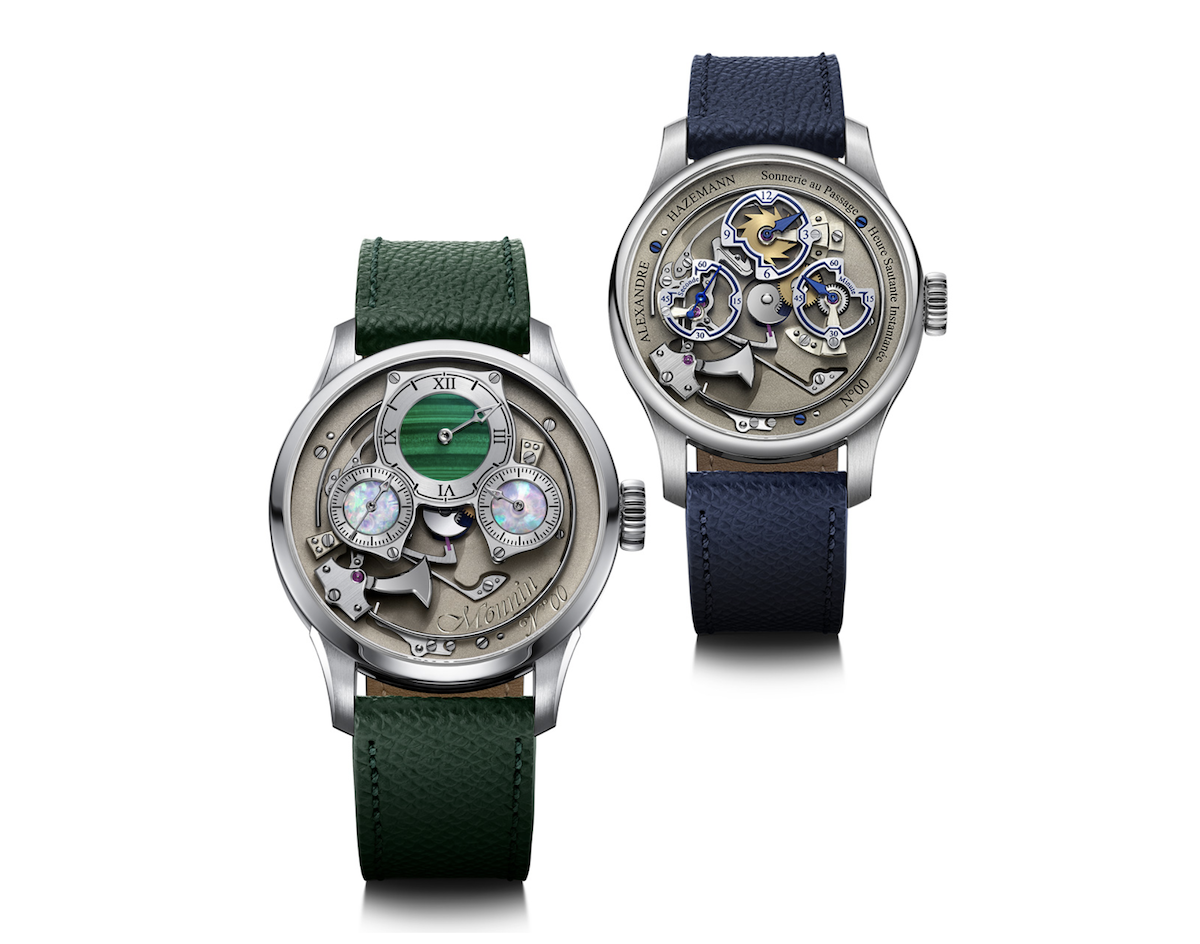
The School Watch exists in two versions, each limited to 10 pieces. The Hazemann edition is the technical expression: openworked sub-dials, blue accents, and a monobloc case middle. Meanwhile, the Monnin edition is the artistic counterpart: malachite and opal sub-dials, soldered lugs, and a different case profile entirely.
Each version bears only one maker's name on the dial. The idea is not a sporty-versus-dressy split; it is a philosophical one. Two watchmakers trained together at the Lycée Edgar Faure in Morteau, built their school watches collaboratively, and then channelled that shared foundation into distinct personal visions.
This duality is embedded in the brand's DNA, and it is the most honest articulation of a partnership this side of Greubel Forsey.
What the Prize Signals
The Louis Vuitton Watch Prize was conceived by Jean Arnault as a vehicle to support independent watchmaking while, not incidentally, reinforcing Louis Vuitton's legitimacy in haute horlogerie. This is LVMH patronage, not LVMH acquisition. Louis Vuitton plays no role in selecting the winner; this year's jury included Kari Voutilainen, Carole Forestier-Kasapi, and Monochrome's Frank Geelen.
The fact that the committee awarded Pagès in 2024—a low-volume artisan, not a brand ripe for buyout—set an important precedent. Awarding Hazemann & Monnin continues in that direction.
But the selection also reflects something else: a shifting appetite among collectors and institutions alike for independent watchmakers who can deliver genuine complications rather than finely finished time-only watches.
The School Watch's Sonnerie au passage, visible dial-side spectacle, and in-house calibre checked every box the jury appears to have been looking for: technical ambition executed with artisanal rigour by makers young enough to represent the next generation.
Hazemann and Monnin now employ around fifteen people at their atelier in Saint-Aubin-Sauges, on the shore of Lake Neuchâtel. A new variation of the School Watch is expected later this year, and a new complication in a new case is slated for 2027. All twenty pieces of the first two editions have been sold and delivered. That may be the most important distinction of all.
This is not a watchmaking dream validated by a trophy. It is a watchmaking reality that has happened to win one.
Sticker Price CHF 59,000—approx USD 74,500. More information on Hazemann & Monnin here.