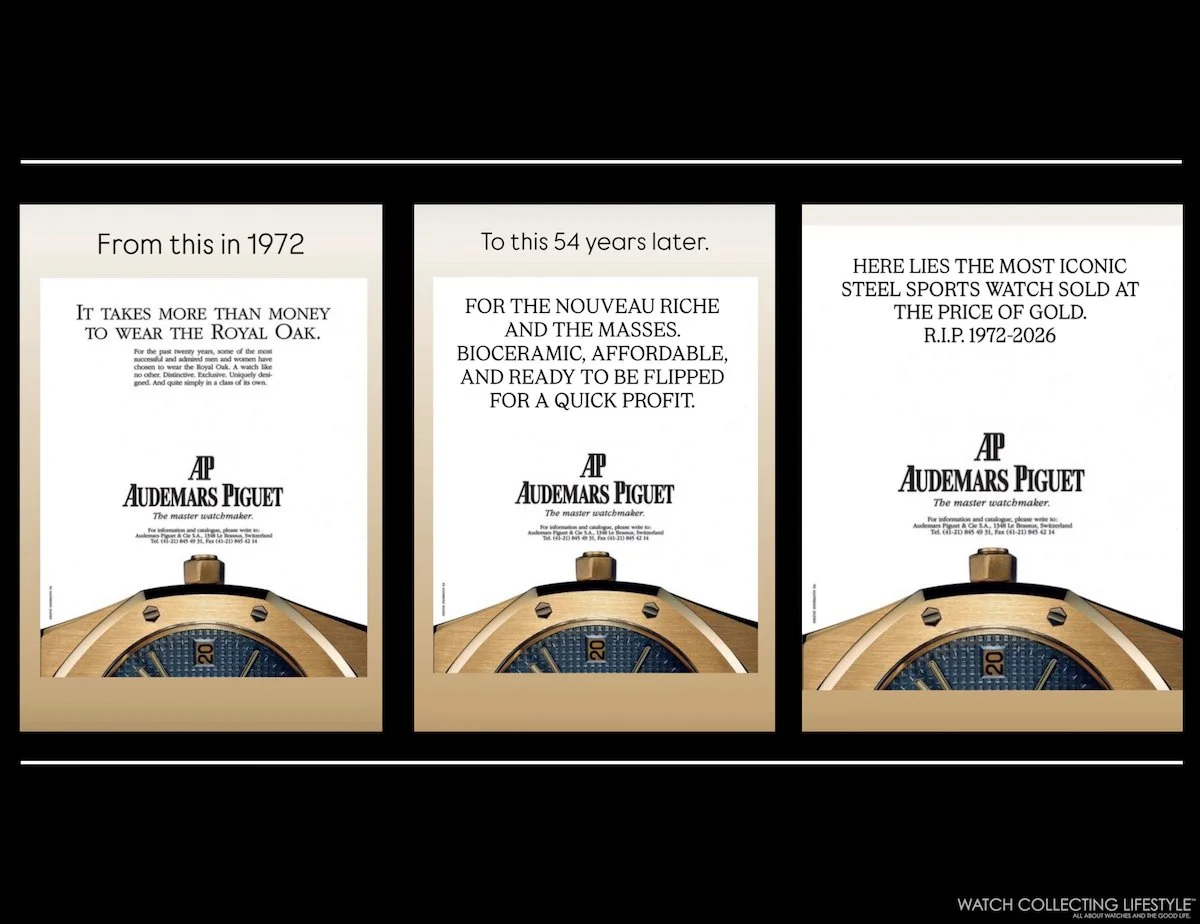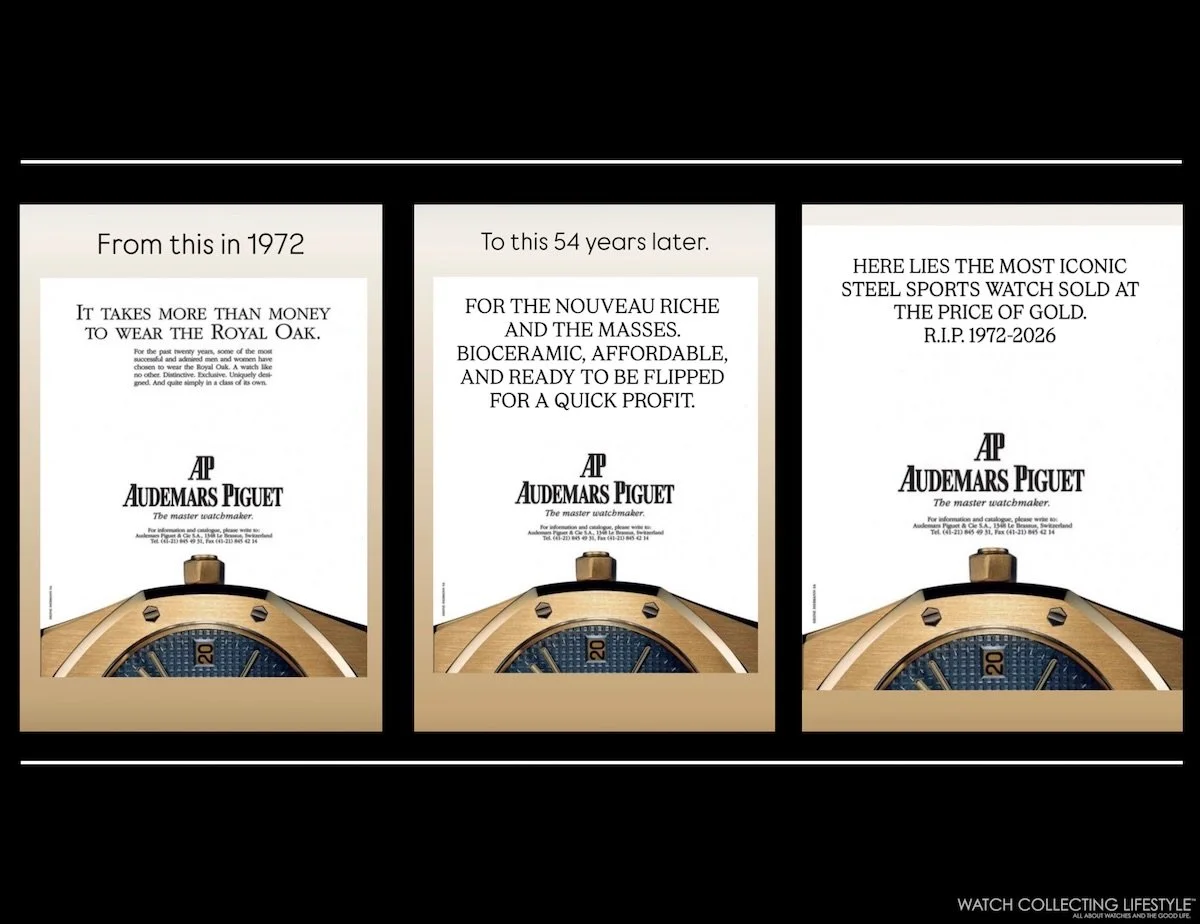
The announcement of the Swatch x Audemars Piguet Royal Pop has shaken the watch world this week. Before we continue beating a dead horse and discussing what AP has become, it is worth remembering what this brand once built. For decades, Audemars Piguet operated as one of the most daring materials laboratories in watchmaking—not just in the Royal Oak Offshore collection, but also across the broader Royal Oak family. Tantalum in 1986. Forged carbon in 2007. Cermet in 2010. Bulk Metallic Glass in 2021. These were not marketing decisions. They were engineering commitments, each one a first for the industry, each one executed on a watch that collectors would spend years hunting. The Royal Oak Offshore, in particular, produced some of the most technically audacious and scarce references in AP’s history—and the watches below serve as evidence. Not just for how they looked, but for what they were made of, how few were built, and what they represented.
There is also a footnote worth savoring. The man who commissioned Emmanuel Gueit to design the original Royal Oak Offshore—Stephen Urquhart, Joint Chairman at AP when ‘The Beast’ debuted in 1993—left Le Brassus in 1997 and returned to the Swatch Group, eventually becoming President of Omega until his retirement in 2016. Omega, of course, is owned by Swatch Group. The same conglomerate that AP has now handed its most iconic silhouette to for a BioCeramic retail collaboration. The circle is complete and not in a good way.
Royal Oak Tantalum
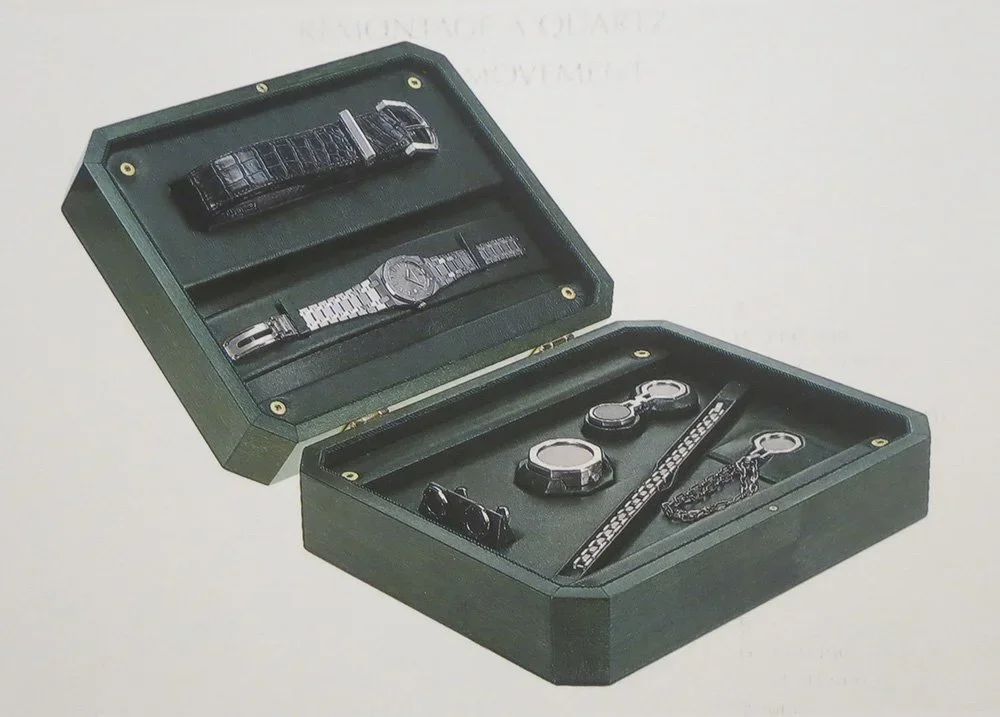
The Royal Oak in Tantalum predates the Offshore entirely and deserves its place here precisely because it shows how deep AP's material ambition ran. First introduced in 1986, tantalum is a very dense, blue-grayish metal with extraordinary corrosion resistance and a lustrous finish unlike anything else in the case material canon. Based on our research, it seems that, at the request of King Juan Carlos of Spain, who wanted a Royal Oak with a more stealthy tone, AP initially explored this material. This material appeared across multiple Royal Oak references, including reference 14486, reference 14790, the Royal Oak Championship—including the Nick Faldo Box Set—, and the Perpetual Calendar references, in combinations with rose gold, yellow gold, and platinum. The tantalum and platinum Perpetual Calendar is arguably the rarest and most coveted Royal Oak of any generation. AP advertised it as "a privilege to possess." They were not wrong.

Royal Oak with Bulk Metallic Glass Bezel
The Royal Oak Jumbo Extra-Thin ref. 15202XT with Bulk Metallic Glass bezel represents the most recent chapter in AP's material story. Created as a unique piece for the ONLY Watch 2021 auction, this was the first use of Bulk Metallic Glass—a palladium-based amorphous metal alloy used in micro-electronics—in the Royal Oak collection. When cooled rapidly, BMG shares characteristics with glass: non-crystalline, highly resistant to wear and corrosion, and producing a unique play of light when hand-polished. AP subsequently deployed BMG on the bezel, caseback, pushers, and crown of the Royal Oak Extra-Thin Selfwinding Flying Tourbillon Chronograph RD#5—their most technically ambitious Royal Oak in decades. A one-of-a-kind piece that sold at auction for CHF 4.9 million. The material intelligence is still there. The question is whether AP's commercial decisions will allow it to matter.


AP First Royal Oak Offshore ‘The Beast’
The Royal Oak Offshore ref. 25721ST 'The Beast' is where it all started. Conceived by Emmanuel Gueit in 1993 for the 20th anniversary of the Royal Oak, The Beast introduced an entirely new design language to Gérald Genta's legacy—massive stainless-steel construction, Therban-clad pushers and crown, and that unmistakable queen-blue Petite Tapisserie dial. We owned one of the first 200 ever made, and our comprehensive guide to this reference remains one of the most detailed available anywhere. The first 100 examples lack the word 'Offshore' entirely on their case backs. Emmanuel Gueit's personal example sold at Phillips Geneva in 2018 for CHF 102,500. There is no more canonical Royal Oak Offshore than this one.

AP Royal Oak Offshore ‘Cut-Out Case’
The Royal Oak Offshore ref. 25770ST arrived in 1997 as the spiritual bridge between ‘The Beast’ and the iconic 'End of Days' limited edition, which marks the first use of black PVD—Physical Vapor Deposition—on any watch in the watch industry. The Royal Oak Offshore 'End of Days' Limited Edition ref. 25770SN.OO.0001.KE.01 was launched in 1999 as the first limited-edition Royal Oak Offshore, produced in a run of 500 pieces in collaboration with Arnold Schwarzenegger while he was shooting the blockbuster movie 'End of Days'. The same 42 mm case architecture, now with a blue Petite Tapisserie dial, gray chrono registers, and a charcoal Kevlar aramid fiber strap that remains one of the most comfortable and distinctive straps AP has ever produced. To celebrate the Royal Oak's 25th anniversary that same year, AP released a small number of 25770ST variants with colorful leather straps—yellow, orange, apple green, bright red, turquoise—that prefigured the chromatic boldness the Offshore collection would later become known for. Pre-'End of Days' scarcity with serious historical resonance.



AP Royal Oak Offshore Perpetual Calendar Chronograph
The Royal Oak Offshore Perpetual Calendar Chronograph ref. 25854TI occupies a different category altogether. The Royal Oak Offshore Perpetual Calendar Chronograph was launched in 1997 and not in 2003 as many mention in other online sources. This is a grand complication expressly made for the Offshore line. This is the one we personally hunted for years—a titanium perpetual calendar chronograph from an era when AP built watches for collectors rather than timelines or flex. Neo-vintage, ultra-rare, and the kind of watch that only real AP connoisseurs can identify on sight. Precisely the point.

AP Royal Oak Offshore Rubberclad
The Royal Oak Offshore Rubberclad ref. 25940 belongs on this list for one reason above all others: it was the first watch in history to use rubber as a primary case material. Launched in 2002, the Rubberclad introduced rubber-clad gold and stainless steel bezels to the Offshore line—a material decision that was as polarizing at the time as it was pioneering. The concept proved significant enough that AP quietly reintroduced a fourth generation under ref. 26238OK, nine years after discontinuation in 2022, a tacit acknowledgment that the Rubberclad had earned its place in the collection's canon. Few Offshores better illustrate the material courage that once defined this line. After the launch of the Rubberclad, other Offshores utilized this bezel cloaked in rubber including the Rubens Barrichello 1, the Orchard Road, the Restivo, the Tour Auto 2009, National Classic Tour 2009, the Gstaad Classic, and the 57th Street Boutique Edition.


AP Royal Oak Offshore Alinghi
The Royal Oak Offshore Alinghi Team ref. 26062FS is where AP's material revolution truly began. Launched in 2007 to commemorate the Alinghi sailing team's America's Cup victory, this was the first watch in history to feature a forged carbon case—a technology borrowed from aeronautics, in which carbon fibers are distributed randomly in a mold and compressed under heat, so no two cases can ever be identical. It also marked the first time AP produced a 44 mm Offshore case, a dimension that would define the collection for years to come. Produced in forged carbon (1,300 pieces), 18K rose gold (600 pieces), and platinum (107 pieces)—all three with a forged carbon bezel—the Alinghi Team is the watch that made everything that followed on this list possible.

AP Royal Oak Offshore Survivor
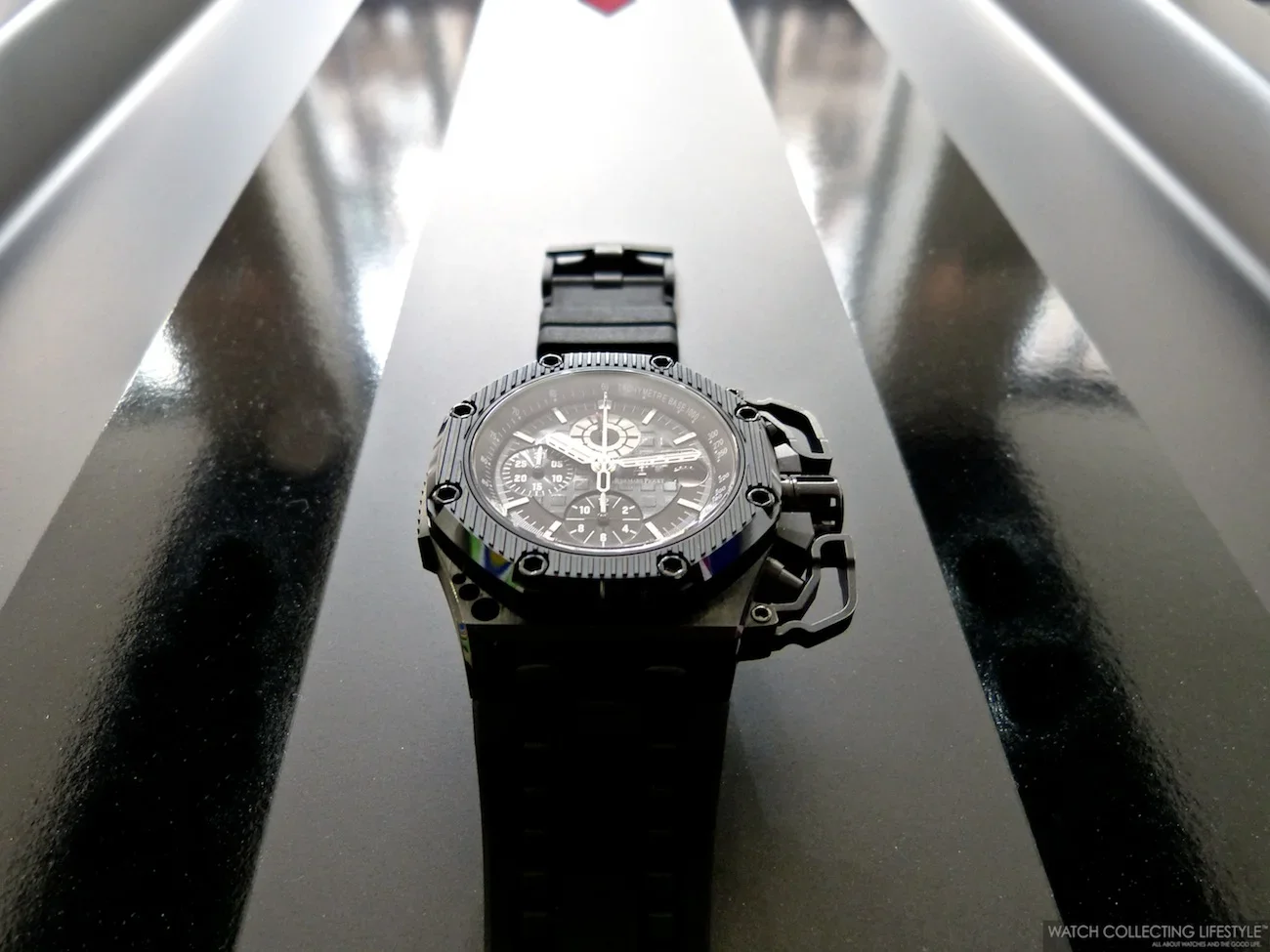
The Royal Oak Offshore Survivor ref. 26165IO launched in late 2008 in just 1,000 pieces and sold out immediately. Blackened perforated titanium, grooved ceramic bezel, ceramic chrono pushers—this was the watch that fundamentally changed the direction of the entire Royal Oak Offshore collection. We have always maintained that without the Survivor, none of the more adventurous material combinations that followed would have existed.
AP Royal Oak Offshore Jarno Trulli
The Royal Oak Offshore Jarno Trulli ref. 26202AU is where the Offshore's material story gets genuinely interesting. Launched during the 2010 Formula One Japanese Grand Prix, this was the first watch in history to feature a cermet bezel—a ceramic-metal composite used in space shuttle heat shields, rated at 1,450 Vickers hardness and approaching diamond's 2,400. The result was a mirror-like, silvery-gold finish on a forged carbon case with titanium pushers, making the Trulli one of the stealthiest and most technically sophisticated Offshores ever released. Finding one for sale remains nearly impossible.

AP Royal Oak Offshore Michael Schumacher
The Royal Oak Offshore Schumacher ref. 26568OM was the second and final time AP used cermet in 2012. Available in titanium (1,000 pieces), rose gold (500 pieces), and platinum (100 pieces), the Schumacher remains the most coveted limited edition Offshore of all time. The rose gold reference tells you everything about how AP once thought about this collection—a precious-metal case with an advanced composite bezel, checkered-flag dial detailing, and Méga Tapisserie execution that was completely uncompromising. The platinum version at 100 pieces is essentially a ghost.

AP Royal Oak Offshore Diver Forged Carbon
The Royal Oak Offshore Diver ref. 15706AU is the Offshore Diver taken to its logical extreme. The Offshore Diver was first released in 2010 as an ISO 6425-certified diving watch with all the necessary credentials. Then, in 2012, this was the first and only time AP produced the Diver in forged carbon—a case material so inherently individual that, per AP's own forged carbon department, no two examples can ever be identical. This material was first presented with the Royal Oak Offshore Alinghi in 2007 and then the Royal Oak Offshore Bumble Bee in 2009. The marbled, satiny surface can only be truly appreciated under natural light, and the yellow accents against the black—more graphite looking—ceramic bezel provide just enough contrast without tipping into ostentation. Titanium case back, pin buckle, and plots keep the weight barely perceptible on the wrist. Discontinued, naturally—because AP has never been able to leave a good thing alone.

AP Royal Oak Offshore Ceramic
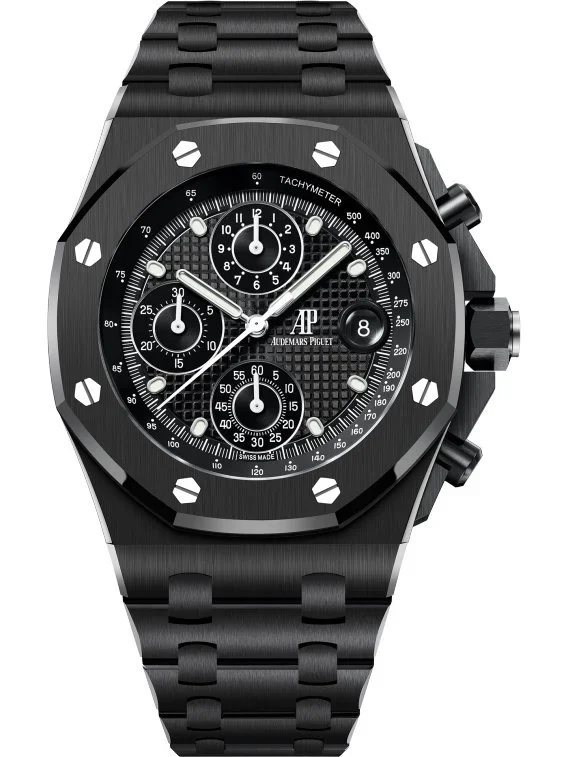
The Royal Oak Offshore All Black Ceramic ref. 26238CE brought a different kind of scarcity — not limited production, but total material commitment. An all-ceramic case, bezel, pushers, crown, and bracelet powered by the then-new Calibre 4404 flyback chronograph. The watch reads like a stealth instrument. We called it the 'End of Days' when we first published on it in 2023, and we stand by that.
From Materials Laboratory to BioCeramic Swatch Boutique
The thread connecting all of these is material intelligence deployed with intention. AP used cermet only twice. Forged carbon was abandoned after a handful of references, including the Royal Oak Offshore Bumble Bee and the Royal Oak Offshore Diver. The 25854TI perpetual calendar in titanium was never replicated at that level of complication. Tantalum was phased out in the early 1990s. These are not marketing exercises; they are watches that required genuine engineering conviction, and that is exactly what makes them irreplaceable.
Which is precisely why the Swatch x Audemars Piguet Royal Pop fiasco stings as much as it does. When you look at the references above—the engineering ambition, the material firsts, the scarcity that was earned rather than manufactured—and then consider that the same octagonal bezel is now destined for Swatch boutique shelves in a BioCeramic case made of two-thirds ceramic and one-third plastic—a compound Swatch's own patent classifies as a "heavy plastic material"—the contrast is not just jarring.
It is a statement about how far AP has drifted from what once made the Royal Oak and Royal Oak Offshore worth coveting in the first place. Known only by those who know.