The tourbillon remains the most overused word in luxury watchmaking and, simultaneously, the complication most capable of separating genuine mechanical ambition from decoration. Almost every manufacture offers one, but very few deliver something really defining. Over the past twelve months, WCL has published coverage on dozens of tourbillon watches across every price segment and philosophy. These five tourbillons we have here have stood apart, not because they were the most expensive or the most limited, but because each one answered a question that had not previously been asked, or answered an old question with new conviction.
These five watches share nothing in common except the complication that names them and the conviction with which each manufacture pursued its own definition of what a tourbillon can be. From 1.85 mm of thickness to USD 10 million of diamonds, from Saxon restraint to Genevan independence, the range is the point. The tourbillon is not one thing. It never has been. The best examples remind us why.
01 — Bvlgari Octo Finissimo Ultra Tourbillon
When Bvlgari launched the Octo Finissimo Tourbillon in 2014, it started a decade-long campaign of thinness records that has now produced ten world records and the GPHG Aiguille d'Or. The Ultra Tourbillon is the current endpoint of that campaign: 40 mm in diameter, 1.85 mm in total thickness, powered by the manual-wound BVF 900 calibre with 240 parts protected by six patents. Those numbers make it the thinnest tourbillon watch ever produced. What earned it a place on this list is not the record itself but the skeletonization that made it possible. Bvlgari pushed transparency to an extreme where the movement becomes the watch—light passes through the entire structure, and the rhodium-plated tourbillon bridge and balance catch it from every angle. Limited to 20 pieces at USD 678,000, this is engineering operating at the boundary of what mechanical watchmaking can physically sustain. Read the full editorial here.

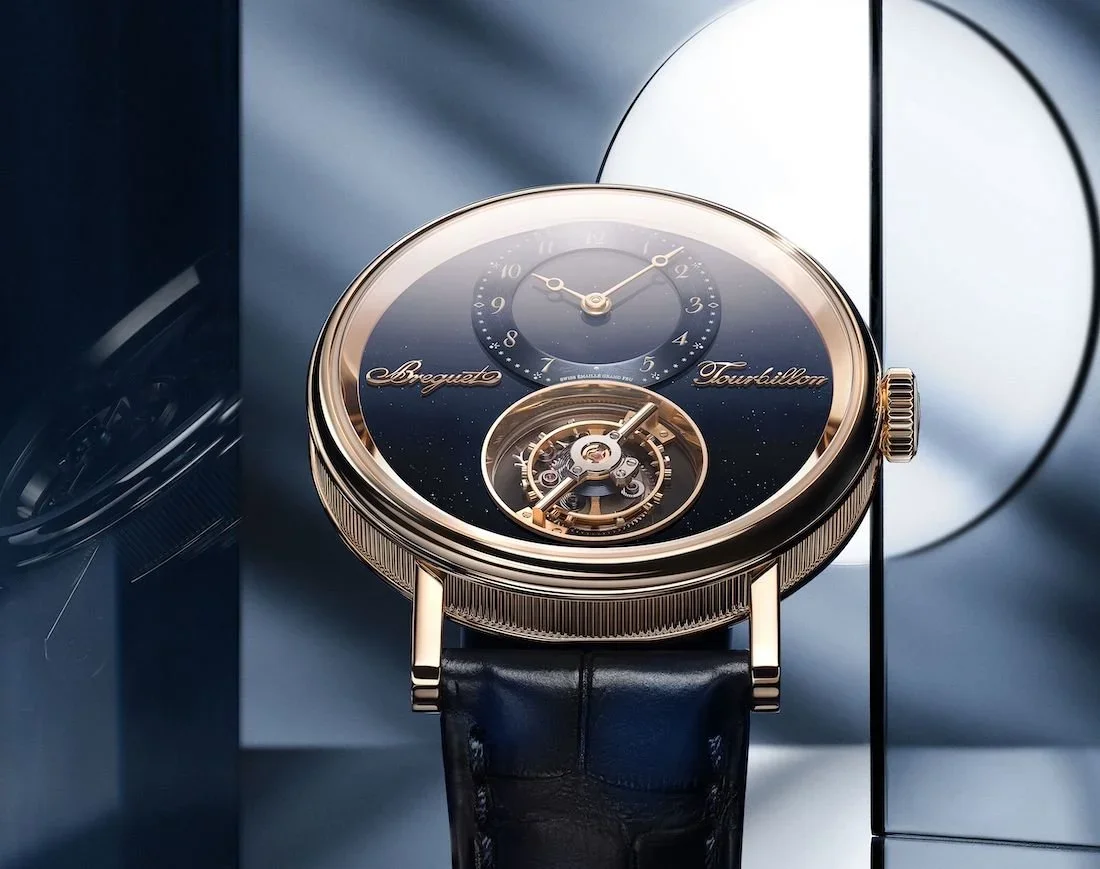
02 — Breguet Classique Tourbillon Sidéral ref. 7255
Abraham-Louis Breguet patented the tourbillon on June 26, 1801. On that exact date in 2025, the house released its first flying tourbillon—224 years later. The Sidéral ref. 7255 is a 50-piece limited edition in 38mm Breguet gold, a proprietary alloy that recalls eighteenth-century precious metals, fitted with the new Quai de l'Horloge guilloché pattern inspired by the curves of the Seine around the Île de la Cité. The flying tourbillon is elevated 2.2mm above the main plate and mounted on sapphire components with anti-reflective coating, rendering the support structure virtually invisible. The effect is celestial — the cage appears to orbit freely above a Grand Feu aventurine enamel dial whose metallic particles ensure no two pieces share the same night sky. The Calibre 187M1 is a manual-wound entirely new movement. What Breguet achieved here is not simply a mechanical first for the house but a philosophical one: the inventor of the tourbillon finally letting the complication float free of its cage. Read the full editorial here.
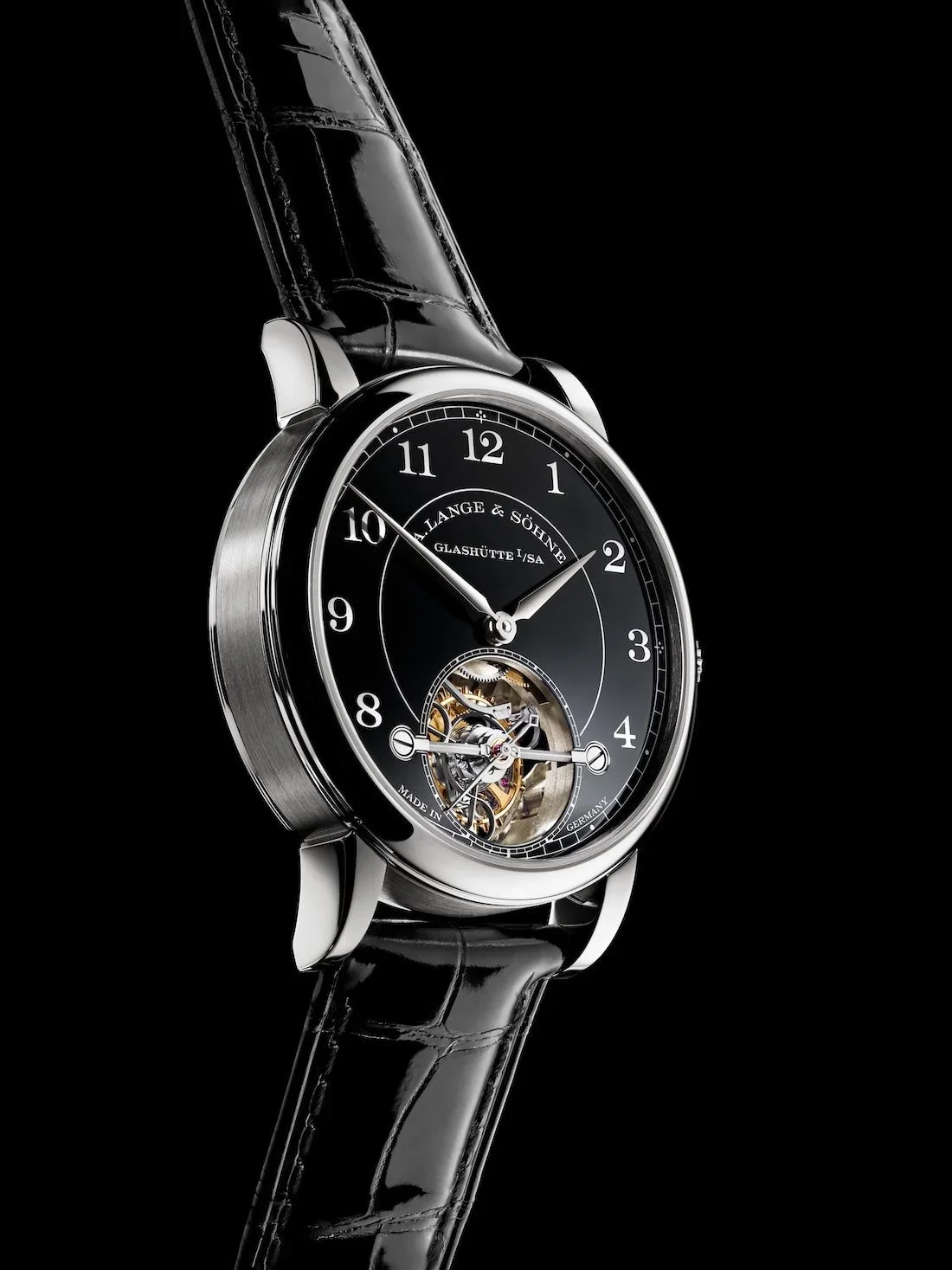
03 — A. Lange & Söhne 1815 Tourbillon Black Enamel
Lange's approach to the tourbillon has always been defined by restraint and finishing rather than spectacle, and the 1815 Tourbillon in platinum with black Grand Feu enamel is that philosophy at its most distilled. This is the third expression of the 1815 Tourbillon family—following the pink gold argenté dial and the 100-piece white enamel with red numeral—and limited to 50 pieces. The black enamel dial transforms the watch's character entirely: where the earlier versions projected warmth and classical elegance, this one reads as austere, precise, and unmistakably Saxon. The one-minute tourbillon with stop-seconds mechanism remains one of the most finely finished in production, and the movement architecture—visible through the sapphire caseback—continues to set a standard that competitors reference but rarely match. In an era where tourbillons compete on size, speed, and novelty, Lange's contribution is a reminder that perfecting a known form can be as impressive as inventing a new one. Read the full editorial here.
04 — Richard Mille RM 41-01 Tourbillon Soccer
Five years of development, 800 components, and a set of patented complications that no other watch in the world replicates. The RM 41-01 tracks an entire football match from kickoff to final whistle—mechanically logging match phases and recording goals via dedicated counters—while housing a double-column-wheel flyback chronograph and a tourbillon rated to survive 5,000 Gs of shock. The movement is built around functionality that is simultaneously absurd and entirely purposeful: absurd because no one needs a mechanical match tracker on their wrist, purposeful because the engineering required to make it work at this level is legitimate and patented. Limited to 30 pieces across Basalt TPT and dark blue Quartz TPT case variants at USD 1,940,000, the RM 41-01 is Richard Mille at its most Richard Mille—a watch that refuses to justify its existence through convention and dares the collector to meet it on its own terms. Read the full editorial here.

05 — Antoine Preziuso TTR3 Trillion Radiant
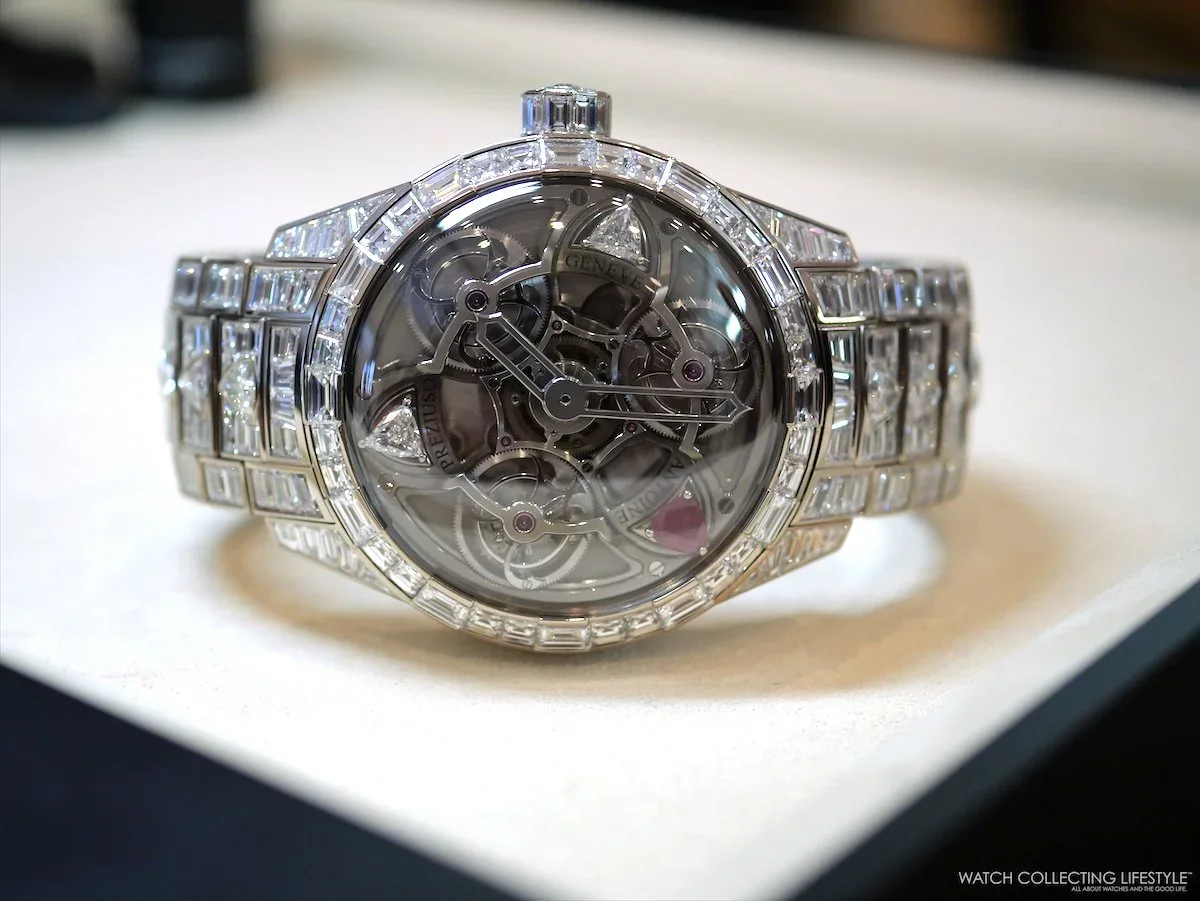
Antoine Preziuso has been building complications under his own name since 1980. The TTR3 Trillion Radiant is what four decades of independence and a complete absence of commercial compromise look like when taken to their logical extreme. Three independent tourbillons are mounted equidistant from the center of a revolving platform, their axes forming an equilateral triangle, housed in a triangular case set with 89 carats of diamonds—including trillion-cut Top Wesselton stones and a pigeon blood red trillion-cut ruby that marks the ten-minute orbital rotation. The manually wound calibre AFP-TTR-3X comprises 570 parts and 65 rubies, with six ball bearings, the smallest measuring 1.6mm in diameter. At USD 10 million, this is not a watch that participates in the market. It exists outside it. What earns the TTR3 Trillion Radiant its place here is not the price or the carat weight but the fact that a father-and-son Geneva atelier—selling through personal relationships, not retail networks—produced a piece of this mechanical and artistic ambition entirely on their own terms. Read the full editorial here.