From time to time we receive emails from watchlifestylers that want to share their watch collections with us. While we only feature these collections sporadically as we get dozens of emails every month, we are always very careful on featuring only those collections or timepieces that spark our interest and those which we believe would be appealing to our readers. Last week, we received an email with an interesting subject line: "Dozen Bubblebacks, All Rare and in Working Condition". As soon as we opened the email and read the kind words from this collector, we knew we had to schedule a private meeting to peruse these timepieces and feature them here. The collector who prefers to remain anonymous, is a fine gentleman that currently lives in Chicago and that spent 10 years hunting down these fascinating 'Bubblebacks'. In his own words: "once I bought my first 'Bubbleback' —pictured below—, I knew I had to get rid of all the other watches that I had been collecting for years and focus my attention on this beautiful Rolex icon".
Rare Bird: Audemars Piguet Royal Oak Offshore 'Pride of Mexico' Limited Edition. A Must Have for Mexican Watchlifestylers.
A few days ago, we heard through the grapevine that a close friend had somehow sourced a brand new in box Audemars Piguet Royal Oak Offshore 'Pride of Mexico' limited edition. Thereafter, we decided to pay him a visit and work on these images and review for those of you that still feel Mexican at heart. This very special watch was released in 2010 by Audemars Piguet in a limited edition of 200 pieces in titanium with stainless steel bezel ref. 26297IS.OO.D101CR.01 and in a 100 pieces in 18K rose gold ref. 26297OR.OO.D101CR.01. Soon after its release, the watch sold out. While many gray watch dealers claim to have these watches in stock, they don't and finding a brand new one, is as hard as finding a needle in a haystack.
The 'Pride of Mexico' was released as a celebratory piece to commemorate the Bicentennial of the Mexican Independence using the standard 42 mm Royal Oak Offshore case, a white silvery dial with some key color accents and equipped with a very elegant dark green —almost black looking— alligator hornback leather strap with light green contrast stitching.
Fitted with a 'méga tapisserie' white silvery dial with green Arabic numerals and a red chrono seconds hand, the watch has just the right amount of color to celebrate Mexico's Independence the right way without overdoing it. The three colors utilized in its dial are representative of the Mexican flag and are very well executed in this timepiece. The 'méga tapisserie' dial is quite nice and shimmery when exposed to fluorescent light sources and the numerals and hands feature luminescent material, a must have on a Royal Oak Offshore.
Flipping the watch over reveals a very nice surprise that is engraved on the case back. The engraving, an image of the 'Ángel of Independence' that is located on a roundabout on 'Paseo de la Reforma' —Mexico City's most important avenue. The 'Ángel of Independence' is a constant reminder of the War of Independence against Spain —which lasted eleven years and eleven days from September 16th, 1810 until September 27th, 1821— and is also one of the most beautiful and iconic landmarks in all Mexico City. The 'Angel of Independence' most commonly known as 'El Ángel' was built in 1910 to commemorate the centennial of the beginning of Mexico's War of Independence and years later it was turned into a mausoleum where the remains of the most important Independence war heroes are kept.
To round out this amazing limited edition watch, the Audemars Piguet Royal Oak Offshore 'Pride of Mexico' limited edition is presented in a special wooden box with the three colors of the Mexican flag and topped with a round plate that features the same engraving of the 'Ángel of Independence' that appears on the case back of the watch. The beating heart inside this watch is the Audemars Piguet automatic calibre 2326/2840 —second generation movement inside the Royal Oak Offshores but not the latest one calibre 3126/3840— which provides a power reserve of 38 hours when fully wound.
On the wrist, the watch wears true to its size but heavier than other titanium Offshores due to its stainless steel bezel. In reality is hard to tell the difference in weight between this watch and a regular stainless steel Offshore. If words like 'Bosques', 'Bandasha', 'Teca', 'La Anáhuac' or 'El Baby' are very meaningful to you and every time you hear them you feel transported to your 'wonder years' in Mexico City, then you know that sooner rather than later, this particular limited edition Audemars Piguet will become part of your collection. Let the hunt begin!
Sticker Price $29,000-34,000 USD. For more info on Audemars Piguet click here.
Experience: London's Andaz Liverpool Street Hotel. Just as Exceptional as the Girard-Perregaux 1966 Platinum on the Wrist.
The Andaz Liverpool Street Hotel in London is one of the original London railway hotels, formerly opened as the Great Eastern Hotel and housed in a beautiful red brick Victorian building dating back to 1884 right behind the Liverpool train station and a couple blocks away from iconic Gherkin building. The Andaz is the perfect hotel to help you overcome your jet lag after a long transatlantic flight and welcome you with a perfectly nested and nicely stocked watch boutique —Carr Watches— right next door. Once inside the hotel, you will be pleasantly surprised by its ultra modern and minimalist decor that is the common denominator in boutique hotels like this. As you walk in, you will realize there's no check-in desk so just go ahead and make yourself comfortable in one of their elegant leather chairs or chaise lounges. Within seconds, someone from their friendly staff will come greet you, ask you if you need any water and check you in without any hassles. As you take a deep breath, you'll sense the beautiful scents from their candles that are perfectly placed around the lobby area and that make the space super cozy and intimate.
Before heading upstairs to your room, make sure you stop by their intimate coffee lounge —right before the lifts— to get some well needed caffeine from their perfectly calibrated Nespresso machines or perhaps a cup of English tea or maybe just some pear elderflower refreshing soda. Now, if you have a sweet tooth and you like to have your coffee or tea with some shortbread biscuits, just help yourself to the canisters on top of the wooden block table filled with delicate and freshly baked goodies, all at your fingertips.
As you head upstairs to your room, you can't stop thinking about the beautiful watches you saw at Carr Watches as you were walking into the hotel. As you walk into one of their beautiful modern rooms and you sit down on the inviting red chair in the corner of the room to do the first watch change, you realize you shouldn't be in the room too long as you want to head downstairs and make sure you take a closer look at the amazing Audemars Piguet Royal Oak Offshore End of Days you saw upon arrival. The last thing you want, is for another watchlifestyler to get there before you do and buy it.
As you head out of your room, you spend some time checking out the space and the tasteful architecture inside the hotel. For some reason, the circular opening across from the lifts reminds you of the Guggenheim as you look downstairs. After snapping a few pictures you are finally back in the lobby to go do some watch shopping.
After a nice visit at Carr Watches —featured here—, you walk all the way to the London Bridge with your mind full of ideas on what to buy next and see if you can make a decision the next morning. Honestly, you just flew across the globe and you still have a full day of watch shopping in London —one of the watch shopping capitals of the world as we published it here— before you end up making an impulse buy. As you walk back into the hotel you are starving; therefore, you decide to check one of their seven restaurants and bars to choose from. You can savor some afternoon tea and British fine dining in London's highly-reviewed 1901 Restaurant & Wine Bar; have some authentic Japanese cuisine in Miyako; a brasserie grill menu in Eastway; traditional English pub fare in George or for the perfect place to meet, relax or party the night away, the new Catch Champagne Bar & Lounge. Since it's your first night, you want to take it easy and you head to Catch Champagne Bar & Lounge where you can have a little bit of everything while sipping a few glasses of your favorite Laurent Perrier Rose champagne.
Pleasantly satisfied with your meal, you feel you're not ready for bed yet and you decide to have a nightcap drink at their pub named George. Since the name of the pub reminds you of a very dear 'drinking friend' from New York City, you decide to have a few Bombardiers and even a Symonds cider. Now, you are perfectly relaxed and ready for bed. As you head upstairs to dream about watches and peacefully rest in your comfy bed, you realize you might not even be able to fall asleep thinking of all the watches you'll see the next day on Old Bond Street and New Bond Street. Sweet watch dreams!
For more info on Andaz Liverpool Street Hotel click here.
News: Armin Strom Continues Partnership with F1 Team Marussia. It's Been Four Consecutive Years Now.
We have some great news for all our readers that our Formula One fans —and we know it's most of you. Armin Strom, is pleased to announce the continuation of its collaboration with the Marussia F1 Team. Armin Strom will be acting as the official timing partner for the Anglo-Russian Formula 1 Team for a fourth consecutive season. With the dramatic new regulations introduced for the 2014 season as we shared them here, will see some important technological developments potentially upsetting the balance of power at the front of the grid.
Equipped with a Scuderia Ferrari powertrain, the Marussia F1 Team hope to improve on their 2013 achievement of the all-important 10th position in the constructors’ championship. With Max Chilton, friend and ambassador of the Biel manufacturer, being retained as a race driver after an impressive debut season, Armin Strom is proud to have Max as its brand ambassador within the paddock.
The exceptionally strong relationship between the Team and the Manufacturer has developed over the past seasons, and this has led to Armin Strom creating watches for Baselworld 2014 that incorporate the precision and composites used to build the Marussia F1 Team MR03. Here are the images of the five watches that currently conform Armin Strom's Racing collection and once we are reporting live from Baselworld 2014 we will bring you images of the new timepieces to be unveiled there.
For more info on Team Marussia click here and for Armin Strom here.


Rare Bird: Patek Philippe 18K Gold Perpetual Calendar with Moon Phases ref. 3448 for Tiffany & Co. To Be Auctioned by Leslie Hindman Auctioneers. UPDATE: Hammer Price.
On April 8, 2014 our friends at Leslie Hindman Auctioneers will host perhaps the most impressive Timepieces auction in their history. This upcoming sale No. 294, will include 91 lots with rare and exclusive timepieces coming from different Estates including the property from the Estate of Gerard L. Cafesjian from Naples, FL, the property from the Estate and Trust of Elise Reeder Olton from Boca Raton, FL, the property from the Collection of a Member of the Royal Family of the United Arab Emirates and a property of a Palm Beach Estate. The auction, to take place next April 8th at 5:30pm CST, will include several highly collectible Patek Philippe timepieces as well as a nice assortment of vintage and modern timepieces from Vacheron Constantin, Audemars Piguet, Girard-Perregaux, Rolex, Longines, IWC and Corum amongst others —we will be showing you in the next weeks some of the special pieces they will be auctioning. Nevertheless, the star of the auction without a doubt will be a very rare Patek Philippe 18K Yellow Gold Perpetual Calendar with Moon Phases ref. 3448 for Tiffany & Co. with movement number 1,119,164 and case number 325,520.
This fascinating Patek Philippe 18K Yellow Gold Perpetual Calendar with Moon Phases ref. 3448 for Tiffany & Co. circa 1970, features an 18K yellow gold case measuring 37.50 mm in diameter and 12 mm in thickness. The watch features a silvered dial with day and month apertures at 12, a date and moon phase indicator at 6 o'clock, dauphine hands, pearl minute track, raised gold hour markers and with the Tiffany & Co. imprint on the dial as this particular watch was originally sold by them.
While this example to be auctioned next month, is nowhere near the rarity of the Patek Philippe 18K Yellow Gold Perpetual Calendar with Moon Phases ref. 3448 Blue dial from 1978—probably a unique piece and only three other examples with color dials— sold at the Christie's auction in Geneva on November of 2013 for a hammer price of $684,626, we are confident that this watch will fetch some serious money. The estimate for this special piece is between $70,000 and $90,000 USD but we are confident the hammer will come down at a higher amount.
Only 586 pieces were ever produced of this fine and rare Patek Philippe ref. 3448 between 1962 and 1985, mostly in yellow gold with handful of examples in white gold and two or three in platinum. The ref. 3448 was the first automatic Perpetual Calendar with Moon Phases and the current example features the upgraded calibre 27-460 Q. Patek retired the ref. 3448 and replaced it with the ref. 3940. The watch is fitted with a snap-on solid case back and correctors for the perpetual calendar and moon phase around the case band. The watch is fitted with an original Patek Philippe black lizard strap with original Patek Philippe 18K yellow gold buckle.
Next month we'll get to see if the current price trend that was set in Geneva at the Christie's auction will continue for these rare and coveted Tiffany & Co. Pateks. As expected, on the wrist this watch couldn't look or wear any better. Ladies and Gentlemen, make sure to check the results of the auction next month or even better, let us know if you became the new owner of this beautiful watch on April 8th. Based on what we have seen in the market in the past couple of months, this watch could sell for another record-breaking amount. Everything is possible when it comes to Pateks. UPDATE: After last night's auction we are pleased to inform you that this watch fetched a hammer price of $182,500 before any buyer's fees.
For more info on Leslie Hindman Auctioneers click here.
Disclaimer: Please do not use our images or content as your buying guide or condition report for this watch. Only Leslie Hindman Auctioneers can provide you with such information.
Experience: Vega Sicilia Tinto 'Valbuena' 5° Vintage 2007. A Superb Wine Just as Good as a Jaeger-LeCoultre Master Ultra-Thin Perpetual.
When it comes to wines from Spain, 'Ribera del Duero' is one of our favorite wine regions and when you think of 'Ribera del Duero', Vega Sicilia is the first name that comes to mind as this is one of the most amazing wineries in that region. Just like when one thinks about one of the best perpetual calendars in the market and the first name name that comes to mind is Jaeger-LeCoultre.
Vega Sicilia Tinto 'Valbuena' 5° vintage 2007 is an spectacular wine mainly made from 'Tempranillo', Merlot and Cabernet Sauvignon grapes and it is one of the best examples of what great wines are supposed to taste, smell and look like. Vega Sicilia is without a doubt the best and most refined wine made in Spain. In 1864, Eloy Lecanda founded the winery that symbolizes the golden legend of Spanish red wine. Throughout its long history, it has belonged to different owners, although it has always maintained an unquestionable personality, making concentrated, mature, generous and extremely elegant.
Vega Sicilia only makes three different wines under the Vega Sicilia winery brand name: 'Valbuena' 5°, 'Reserva Especial' —with no vintage as this is a blend of different vintages— and 'Único'. Vega Sicilia is also the owner of Pintia, Alion —often called the poor man's Vega Sicilia— and Tokaj Oremus which are not sold under the Vega Sicilia name; however, they still happen to also be some of the best wines in the world.
Bodegas Vega Sicilia is located in the town of Valbuena de Duero between Peñafiel and Valladolid in the wine region of Ribera del Duero in Spain. Since 1982, the company is owned by the Alvaréz family. What makes this wine so unique and well balanced, is the aging process. For the 'Valbuena' 5°, the duration of the aging process in wood is three and a half years and during this time, the wine is rotated form new casks to heavily used American oak casks with the only goal in mind of obtaining the perfect balance between the wine and the wood. Once this has been achieved, the wines finally rest in large wooden vats, which prepares them for later bottling to then end their journey with a calm rest in the bottle in specially acclimatised installations. The time they remain there, depends on the format of the bottle: Vega Sicilia 'Único' —750ml bottle— takes three years or more to age in the bottle, while for the 'Valbuena 5°, the period for aging in the bottle is around a year and a half.
Considering the time that it takes for a certain vintage to make it to the stores you are guaranteed a wine with certain level of maturity and perfection that will be ready to be drank. Now, when it comes to Vega Sicilia wines in the U.S., be prepared to look for it as hard as you can as this winery has a very limited production and only 100 stores carry it in the country.
This wine is characterized for its strong notes of black cherry and oak on the palate and a superb delicate finish with almost no acidity or alcoholic taste on the throat. Best paired with some 'Ibérico' ham, lamb or venison.
Sticker Price $180-230 USD. For more info on Jaeger-LeCoultre click here and for Vega Sicilia here.
Watch Goodies: Audemars Piguet Royal Oak Wall Clock. Unboxing an Iconic and Coveted Clock.
The Audemars Piguet Royal Oak wall clock is perhaps one of the most coveted items of watch swag but unfortunately for AP lovers this clocks are not for sale to the public but given by the brand to top clients and 'friends of the brand'. The AP Royal Oak wall clock just like the Royal Oak, has evolved in the last 15 years and the current generation of the clock is not only bigger but nicer. While the previous generation of Audemars Piguet wall clocks is still beautiful and as coveted as the new generation, the older clocks were bulkier and slightly smaller —13" in diameter compared to the 15" diameter of the new ones. While the hex bolts on the new AP clocks are recessed just like on the watches, the previous clocks had protruding bolts that made them look more like a ship porthole. Additionally, there is one other 13" AP wall clock with actual tapisserie and recessed bolts that was launched as a transitional clock right in between the 13" clock pictured below and the 15" on the first picture.
Another big difference between the newer clocks and the older ones, is that the new version comes with an actual raised 'tapisserie', while the older clocks featured a 'tapisserie' that was just printed on the dial. Something we do love about the previous generation of AP clocks is the double baton at 12 o'clock, the super bright luminescent material on the batons and hands and the Swiss quartz movement —ironically, the new clocks feature a German quartz movement.
The Audemars Piguet clocks are typically located in 86 Delta Air Lines Sky Club lounges throughout the United States and internationally, at NetJets locations in Woodbridge, NJ, Beverly Hills, CA and New York City, throughout 21 Four Seasons Hotels in the United States, Canada, Mexico and Latin America and aboard The World by Residensea.
Additionally, you will also find them at the Audemars Piguet boutiques, authorized dealers carrying the brand and at the prestigious Liberty National Golf Club in New Jersey where Audemars Piguet is the Official Timekeeper.
As we mentioned earlier, these clocks are not for sale by Audemars Piguet but from time to time they will pop-up on Ebay or watch forum classifieds posted by private sellers or authorized dealers wanting to make a quick buck. This particular clock was purchased by a very close friend of ours and true watchlifestyler that waited over two weeks to meet with us before unboxing it, so that we could document it. What a great friend!
While we could've done the unboxing at the Four Seasons Hotel in Chicago —since they have a couple Audemars Piguet clocks there—, we decided to honor the German quartz movement in the clock with some beer 'steins' filled with the finest German beer at the Hofbräuhaus here in Chicago. Now, enjoy these images of the iconic Audemars Piguet Royal Oak wall clock. As expected, the finish on the clock is up to par with the finish on the Audemars Piguet timepieces.
Estimated Sticker Price $1,400-2,500 USD. For more info on Audemars Piguet click here.


News: Pre-Baselworld 2014 Arnold & Son Presents the DTE: Double Tourbillon Escapement Dual Time Watch. Another Masterpiece of Horology.
John Arnold was born in Cornwall in 1736. His father was a watchmaker and his uncle a gunsmith, which probably explains his early interest in precision engineering and metalwork. A talented craftsman and scholar, he left England for the Netherlands at the age of 19 after completing his apprenticeship to hone his watchmaking skills. He returned two years later speaking excellent German, which stood him in good stead later at the court of George III, and had established himself as a watchmaker of repute in London's Strand by his mid-twenties. After Arnold presented the smallest repeating watch ever made to King George III and to the court, he rapidly acquired a wealthy clientele. He was one of the most inventive watchmakers of his day and held patents for a detent escapement, bimetallic balance and helical balance spring. Arnold's "No. 36" was the first timepiece to be called a chronometer, a term reserved for unusually precise watches to this day. Arnold also played a central role in the events of his day. Along with other watchmakers, he addressed the problem of determining longitude, and won several grants and awards offered by the British Parliament. He enjoyed such respect in his profession that he became a close friend of Abraham-Louis Breguet. The timepieces of Arnold and his son accompanied famous explorers on their voyages of discovery, helped the East India Company establish its empire and how Napoleon Bonaparte himself presented an Arnold clock to the Observatory of Milan in 1802.
John Arnold and Abraham Louis Breguet, silver cased chronometer with tourbillon and spring-detent escapement, London, England, 1774 and Paris, France, 1808.
250 years later, Arnold & Son celebrates its 250th anniversary with another masterpiece of horology in a limited edition of only 28 pieces, the DTE: Double Tourbillon Escapement Dual Time watch. A generous 43.5 mm watch 18K red gold with two white dials —one with Roman numerals and the other with Arabic numerals— accentuated with blued hour and minute hands. The DTE is a masterpiece of symmetry, balance and three-dimensional beauty combined with technical foresight and ultimate performance precision.
The double barrels of the watch offer a superb 90 hours of power reserve. In typical Arnold & Son style, the watch is incredibly detailed and features superlative Haute Horlogerie finishing. The dial side of the timepiece offers symmetry and depth. It features two white lacquered domed dials – one each at 12 o’clock and 6 o’clock – for the dual time displays. The two tourbillon escapements are harmoniously balanced at 3 o’clock and 9 o’clock and seem to float over the dial thanks to their alluring raised 18K red gold bridges. The backdrop for these double lacquered dials and double tourbillon escapements is a magnificently decorated vertical Côtes de Genève stripes plate.
The two crowns – one each for setting the local and the home time – are located at 2 o’clock and 8 o’clock, and the two mainsprings are wound using the crown at 2 o’clock. In addition to the double tourbillon escapement and the dual dial/dual time indication, the watch is incredibly efficient in that it not only offers local time in hours and minutes, but also offers hours and minutes of a second time zone to be set separately —thereby enabling the wearer to have precise time in zones that differ from Greenwich Mean Time by quarter-hour or half-hour increments. Each time zone display has its own gear train and its own tourbillon escapement.
The watch, powered by the all-new mechanical hand-wound calibre A&S8513 —visible via the display case back—, brings the centuries-old tradition of double movements back to life in 21st century style. The watch is fitted with an very elegant hand-stitched brown or black alligator strap.
Sticker Price $210,000 USD. For more info on Arnold & Son click here.
Technical Specifications Arnold & Son DTE ref. 1DTAR.L01A.C120A
Case: 18K red gold measuring 43.5 mm in diameter with display case back.
Movement: Calibre A&S8513 Exclusive Arnold & Son mechanical double tourbillon movement, hand-wound, 42 jewels, diameter 37.3 mm, thickness 8.35 mm, power reserve 90 hours, double barrel, 21,600 vph. Fully decorated nickel-silver movement, rhodium treated with hand-chamfered bridges and polished edges, fine circular graining and 'Côtes de Genève' rayonnantes, plate dial side with 'Côtes de Genève', circular satin-finished wheels with
hand-chamfered and polished edges, blued screws with bevelled and mirror-polished heads.
Functions: local hours and minutes, GMT hours and minutes, double tourbillon.
Tourbillon: 18K red gold bridges, satin-finished and mirror- polished surfaces with hand-chamfered and polished edges. Hand-chamfered and mirror-polished tourbillon cages.
Dial: domed and white lacquered.
Crystal: cambered sapphire with anti-reflective coating on both sides.
Water Resistance: 30 meters.
Strap: Hand-stitched brown or black alligator leather.
Limited edition: 250th Anniversary, 28 timepieces.
News: Louis Moinet Presents the Qatar Tourbillon at Doha. A Timepiece with Two Fragments of the Only Meteroite Ever Found in Qatar.
Louis Moinet presents the Qatar Tourbillon at the 10th edition of the Doha Jewellery and Watches Exhibition. This new timepiece in an exceptional 18K white gold case measuring 47 mm in diameter, composed of 59 different components and equipped with the Louis Moinet signature crown guard features the essence of this wonderful Middle Eastern country with a hand-engraved applique around the periphery of the dial, depicting sand dunes and two Qatari bent swords. It also features the oldest known fossil on earth, a three-billion-year-old red stromatolite, which is found in the center of the dial, between the tourbillon at 6 o’clock and the visible mainspring at 12 o’clock.
In addition to the ultra special fossil located on the center of the dial, the watch features two fragments of the one and only meteorite ever been found in Qatar and acquired by Louis Moinet to be turned into horological art. The meteorite was discovered in the middle of the desert on May 10th of 2010 by Luc Labenne, the highly-regarded internationally renowned meteorite hunter. This unique meteorite Chondrite type H5-W4-S2 was discovered after a ten-day hunt with ten hunters and three vehicles. According to the Meteoritical Society, the meteorite’s official name is Qatar 001 and it originated from the asteroid belt situated between the orbits of Mars and Jupiter from where it traveled more than 260 million kilometers before landing in the area of Jariyan al Batnah in Qatar.
The view through the Qatar Tourbillon display-back is almost as spectacular as the dial side, with the ‘octopus spring’ of the winding and setting mechanism taking the center stage. This ingenious component is effectively three springs in one —pull-out piece spring, lever spring and click spring— all radiating from the center like the swirling legs of an octopus. The movement plate is engraved with Louis Moinet's “Côtes du Jura” motif. The watch is equipped with a gorgeous dark blue hand-sewn Louisiana alligator leather strap with 18K white gold & black titanium folding clasp with Louis Moinet logo. The Qatar Tourbillon is available in an exclusive limited edition of only 12 pieces.
Sticker Price TBC. For more info on Louis Moinet click here.
Technical Specifications of the Louis Moinet Qatar Tourbillon
Dial: Hand-engraved dial depicting two bent swords and sand dunes set with Qatar meteorite 001 with exclusive tourbillon escapement, central hour and minutes.
Movement: Manual wound with “octopus” spring, 19 jewels, power reserve of 72 hours, 21,600 vph, tourbillon cage with one full rotation every 60 seconds, side lever escapement, “Côtes du Jura” decoration and blued steel screws.
Water Resistance: 30 meters
Case back: Display case back secured with 6 screws, engraved with individual number and Louis Moinet markings.
Crystals: Sapphire crystal with anti-reflective treatment.
Limited Edition of 12 pieces
Reference No. LM-14.70.21
Insider: Audemars Piguet Royal Oak Offshore 'Oceanografía' Limited Edition. One of the Most Beautiful Offshores Exclusively Made for a VIP Client.
Back in 2012, Audemars Piguet released the Royal Oak book commemorating the 40th anniversary of the birth of the Royal Oak. As soon as it came out, we had to have a copy of it. In the book, not only will you find very interesting historical information about the iconic Audemars Piguet Royal Oak and the Royal Oak Offshore but also great images of vintage advertisements and even pictures of some of the 'friends of the brand', major AP collectors and even some of their brand ambassadors.
In the book, you'll find big names like Ticiane Pinheiro Justus —Brazilian TV Anchor, His Highness Sheikh Hamad Bin Suhaim Al Thani from Qatar, Abdulmagied Ahmed Seddiqi — Chairman of renowned Middle Eastern jeweler Seddiqi & Sons, Claude Nobs —Founder of the Montreux Jazz Festival, Marcus Margulies —one of the biggest AP collectors and owner of MARCUS watches in London, Graeme McDowell, Juan Pablo Montoya, Leo Messi, Sachin Ramesh Tendulkar, Arnold Schwarzenegger, Michael Schumacher and Gerald Genta amongst others. However, there's one picture in the book that caught our attention, the picture of someone named Amado Omar Yañez Osuna, CEO of Oceanografía, S.A de C.V., a Mexican company extremely involved with Pemex —Mexico's Petroleum company— and everything related to offshore oil drilling and offshore oil platforms construction. The watch on his wrist, a Royal Oak Offshore we had not seen until then and that was really beautiful.
In 2013, we were invited to a very exclusive event and one of the attendees was wearing the exact same watch that was featured in the Royal Oak book. Interestingly enough, the gentleman wearing the watch was also Mexican but not the one featured in the book. It is amazing how small the watch collecting world really is. As we started talking about the amazing 'never seen before' Offshore on his wrist, this watchlifestyler shared with us the story behind the watch and allowed us to take these pictures for our website.
According to this watchlifestyler, the Audemars Piguet Royal Oak Offshore on his wrist was a very special edition that was custom made by Audemars Piguet and commissioned by Oceanografía, S.A. de C.V. to commemorate the 40th anniversary of the company. The Royal Oak Offshore 'Oceanografía' Limited Edition bears a beautiful 'mega tapisserie' blue dial with silver registers and yellow Arabic numerals, a yellow chrono-seconds hand, blue therban crown and pushers and a beautiful engraving on the case back with the number '40', the seahorse logo of Oceanografía, S.A. de C.V. and the years 1966-2006. To round out the beautiful color combo and design, the watch is fitted with a blue alligator large square scale strap with yellow contrast stitching and equipped with the usual AP deployant buckle. We were told the watch also came with a second blue strap in smooth calf leather and a stainless steel bracelet.
Frankly, this company could've not picked a better watch to commemorate such an important milestone when you're in the business of oil ships and 'offshore drilling'. The watch, a late F-serial, does not bear any information as to how many pieces were commissioned; however, if our memory serves us correctly, we were told that there were 50 watches ever made —including a solid 18K white gold piece— in order to be gifted to friends, family and business partners. We can only imagine how much Audemars Piguet would charge to do something like this. One thing we can assume is that it wasn't a cheap limited edition and likely no bulk discount was offered. Now, for those of you wondering what small luxuries Oceanografía, S.A. de C.V. was funding with their millions —currently under investigation as published by Bloomberg here—, you may now have a good answer.
On a positive note, we are not sure what you guys think of the color combination, but we think that If Audemars Piguet were to launch an Offshore with the exact same color combination right now, we are confident it would become a huge success.
Estimated Sticker Price $40,000 USD. For more info on Audemars Piguet click here.
Insider: MB&F Horological Machine No.5 in Red Gold. A Fascinating Retro-Futuristic Timepiece in a 66-Piece Limited Edition.
Last month while we were visiting the M.A.D. Gallery in Geneva, we decided to work on this special review with live pictures of the fascinating MB&F Horological Machine No.5 in red gold. After the original Horological Machine N.5 5 in zirconium was presented in 2012, most would wonder why would MB&F craft the HM5 in a limited edition of 66 pieces in red gold. Well, because they thought it would look damn beautiful and they were damn right. Perusing this watch in the flesh was an exhilarating experience and a tremendous joy.
This watch inspired by iconic watches from the 70s —with a similar case shape— like the Girard-Perregaux Casquette LED, the Amida Digitrend Jump Hour and even the Bulova Computron Driver, comes full of surprises.

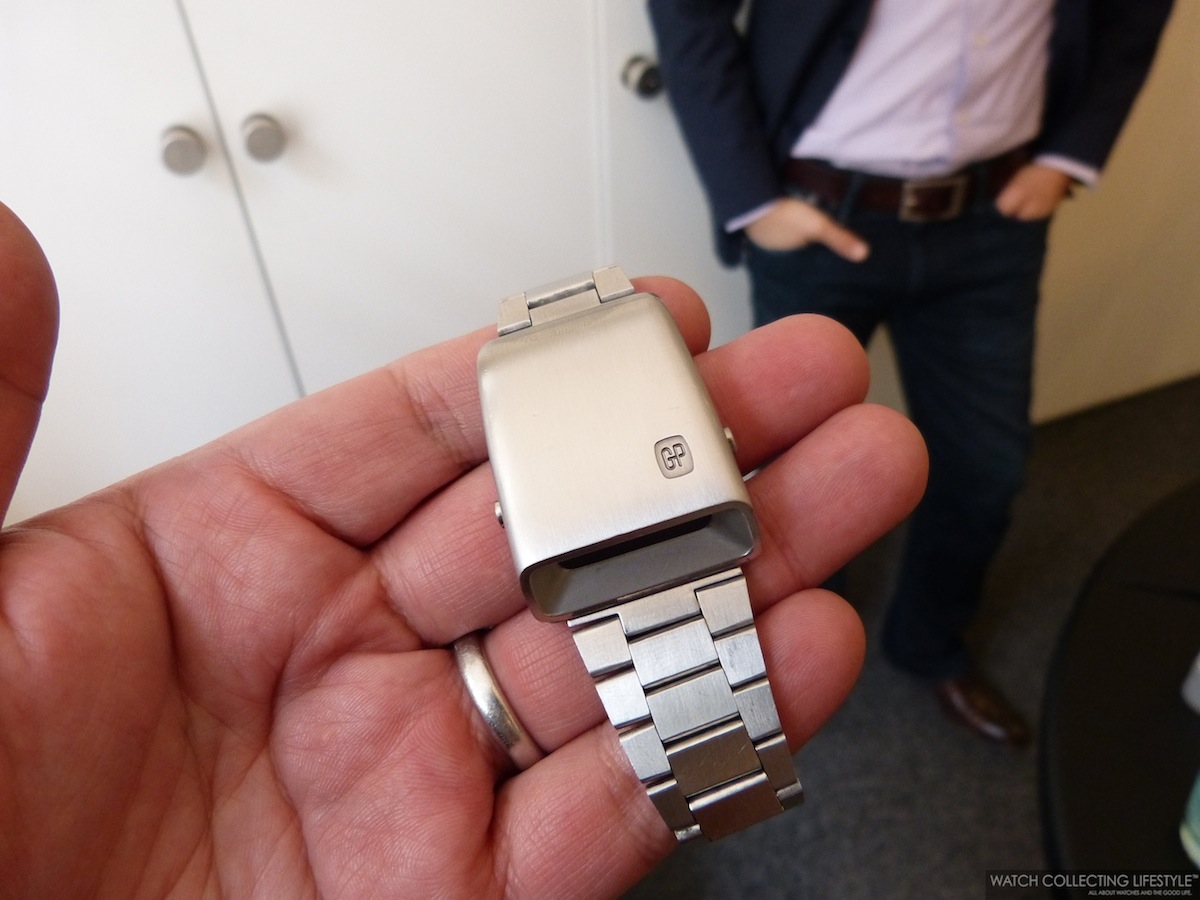

Fitted with an 18K Red gold and titanium case —with internal water resistant titanium engine container— measuring 51.5mm x 49mm x 22.5mm, a slide button to open/close its back louvers and exhaust ports to drain water, the HM5 RT is something out of this world and conceived in the most futuristic and flawless way possible.
Perhaps one of the most interesting features of this fascinating timepiece is the way the hour and minutes are shown via a display that faces the front of the watch, but where the time is indicated with bi-directional jumping hours that are inverted, reflected at a 90° angle and magnified at a 20%. The smoked optical grade sapphire crystal with anti-reflective treatment on both sides and magnification provides excellent readability in any angle. Looking at this watch directly from the front, definitely brings memories of WALL-E the romantic robot from Pixar's science fiction animated movie with the same name.
HM5 RT has a mechanical movement, but its inspired by an era when quartz was king. The rear louvers on super cars block light, but on the HM5 RT they let light in. Befitting its automotive heritage, HM5 RT has exhaust pipes, but they drain water. The gold endowing the HM5 RT case with such a rich lustrous glow was found on earth, but was actually created billions of years ago in deep space. The louvers are angled and the back of the watch appears as if it was the rear window of the iconic DeTomaso Mangusta but fitted with louvers. Frankly, a watch doesn't get any sexier than this.
Via the display case back of the Horological Machine No. 5 —HM5 RT— one can see the amazing beating heart inside this timepieces. The display case back also reveals the surprise of an inner case. Like a Russian Matryoshka doll, peeling away one layer reveals a second case in titanium/zirconium. The reason for housing the movement in an inner container is for water resistance. Jean-François Mojon, Vincent Boucard and the team at Chronode developed the HM5 movement. The automatic calibre is composed of 224 parts, 30 jewels, a battle-axe 22K gold ‘mystery ’ rotor and is fully hand-finished. Opposed to what one would think, the discs with the hours and minuted are actually placed in horizontal position but displayed vertically thanks to the reflection and magnification of a sapphire crystal optical prism. It may appear simple, but it’s very complicated. Jumping hours are bi-directional, enabling the time to be easily set both forwards and backwards —via the crown located at the back of the watch or what would be considered the 12 o'clock position on a conventional watch. The two mineral glass disks of the hours and minutes are supported by a flat wide bridge and the disks overlap to maximize their diameter and space for large legible numerals.
To round out the amazing design of the MB&F Horological Machine No. 5 in Red Gold, the watch is fitted with a black rubber strap with pin buckle. The strap features oval perforations as well as very thin ridges to match the ridges on the back of the case and the oval display window on the front. Although the rubber on the strap is very malleable and comfortable, the ridged texture on it is a magnet for collecting dust and lint.
On the wrist, be prepared to wear a very unconventional watch with a funky but very comfortable fit. Once you strap this timepiece to your wrist, be prepared to be transported back to the future. While the design of the case and the time display window are very reminiscent of those 70s iconic watches, the craftsmanship, finish and overall design of this watch is definitely years ahead of our time. Without a doubt, this is another singular and fascinating creation from MB&F.
Sticker Price $82,000 USD. For more info on MB&F click here.
Experience: Sebastian Vettel's Infiniti Red Bull Racing Formula One Car. Big Changes Taking Place During 2014's Formula One Season.
As we prepare for the 2014 Formula One season to kick-off in two weeks with the Australian Grand Prix on March 14th thru the 16th, we decided to bring you these up close and personal images of Sebastian Vettel's Infiniti Red Bull Racing Formula One car. As you all know, Sebastian Vettel is the current Formula One champion and champion for four years in a row since 2010. In his first year driving for Red Bull in 2009, Vettel finished the season as the youngest-ever World Drivers' championship runner-up and in 2010, he went on to become the youngest driver to ever win the World Drivers' Championship. That same same year, he helped Red Bull win the team's first World Constructors' Championship. Today, he is the youngest triple and quadruple champion that has ever existed in Formula One.
The Infiniti Red Bull Racing F1 car, just like all other Formula One cars, is tightly controlled by the regulations of the FIA in terms of technical specifications and car dimensions. These amazing racing machines cannot be wider than 1.80 meters —70.86"—, longer than 4.63 meters —15' 2"—, taller than 95cm —3' 1"— and the bodywork between the front and rear wheels must not exceed 1.40 meters —4' 7"— in width. As a result of these strict regulations, most constructors will end up with similarly sized cars.
With the exception of the rear wing, moveable bodywork is not allowed. Furthermore, any system, device or procedure which uses driver movement as a means of altering the aerodynamic characteristics of the car's bodywork is prohibited. Formula One cars may be equipped with moveable rear wings which allow the driver to control the wing's angle of incidence —within certain specified limits— from the cockpit with a system widely known as DRS —Drag Reduction System. However, during the race, the system is electronically governed and is only available when a driver is less than one second behind another car and going by the DRS detection point at pre-determined areas on the track. In order to use the DRS when available, the driver is alerted via a dashboard light. Once used, the DRS system is deactivated when the driver brakes and the rear wing flap returns to its original position.
Certain sections of bodywork, such as the front wing end plates, are required to be thick enough to prevent tire damage to other cars. Any bodywork that flexes excessively, could in theory be used to gain an aerodynamic advantage. Therefore, specific sections of the bodywork, such as the front wing, must be sufficiently rigid to pass the FIA’s ever more stringent deflection tests.
The construction of Formula One cars and the materials used are also strictly controlled by the FIA regulations in order to maximize the safety of the cars and the drivers. The main structure of the car comprises a safety cell which contains the cockpit plus the flexible fuel cell, which is housed immediately behind —but separated from— the driver. This safety cell must meet minimum size requirements and must have an impact-absorbing structure immediately in front of it. The design of the car must also include an additional impact-absorbing structure at the rear, behind the gearbox, and on the flanks of the car. The car must have two roll structures to protect the driver in the event of the car overturning. One must be immediately behind the driver’s head, the other at the front of the cockpit, immediately ahead of the steering wheel. The car and its survival cell must pass several strict impact, roll and static load tests before the car is allowed to take to the track.
The size of a Formula One car’s cockpit opening must also comply with strict specifications. Compliance with these specifications is tested by lowering a specially made template into the cockpit. In addition to this, the cockpit must meet numerous other requirements. A driver must be able to get in and out of the car without removing anything other than its steering wheel. Once strapped into the car with all his safety gear on, the driver must be able to remove the steering wheel and get out within five seconds, and then replace the steering within a further five seconds.
When it comes to the engine power of an F1 car, up until 2013 —some big changes will be taking place this season—, a Formula One car’s power unit consisted of a 2.4-litre normally-aspirated V8 engines outputting more than 750bhp and a gearbox with seven forward ratios. Also up until 2013, the teams were allowed unlimited fuel consumption with an average of 160 kilos of fuel per race with two exhaust tail pipes.
A team of specially appointed scrutineers has the power to check cars at any point during a Grand Prix weekend to ensure that they fully comply with technical and safety regulations. Every car is initially examined on the Thursday of a race meeting —Wednesday for Monaco's Grand Prix— and a car cannot take part in the event until it has passed scrutineering. A car must be re-examined by scrutineers if any significant changes are made to it by the team or if it is involved in an accident. In addition to scrutineering, cars are also weighed during the Grand Prix weekend to ensure that they comply with the minimum weight of 642 kilograms —1,415.37 pounds. Cars taking part in Q1 and Q2 are called in at random to be weighed, while all cars participating in Q3 are weighed after the session. Classified finishers are weighed again after the race. Any competitor failing to meet the minimum weight may lose their qualifying times or be excluded from the race results unless this is due to the accidental loss of part of the car.
Watchlifestylers get ready for one of the most exciting Formula One seasons in the last decade as in two more weeks we'll get to see some very exciting changes that will be taking place during 2014's Formula One season, these changes are perhaps the biggest changes we've seen in F1 racing in a very long time.
This upcoming season the cars will be fitted with V6 engines instead of V8s. The new regulations allow for a 1.6-litre turbocharged V6 engine which operates in conjunction with an Energy Recovery System referred to as ERS. The ERS provides an additional 160bhp for 33 seconds per lap. For safety, each car is fitted with ERS status lights which warn marshals and mechanics of the car’s electrical safety status when it is stopped or in the pits. If the car is safe, the lights —situated on the roll hoop and the rear tail lamp— will glow green; if not, they glow red. The lights must remain on for 15 minutes after the power unit has been switched off. The engine must have six cylinders in a 90-degree formation, with two inlet and two exhaust valves per cylinder and a single turbocharger. They are rev-limited to 15,000rpm, have a fuel flow limit of 100 kilograms/hour and produce around 600bhp. They must also have a single tailpipe exhaust.
The gearboxes will now have eight forward ratios which each team must nominate ahead of the season, to compensate for the extra power being generated under braking by ERS, the teams are allowed to use an electronic rear brake control system.
To compensate for the increased weight of the 2014 powertrain, minimum weight has been increased from the current 642kg to 690kg.
For safety reasons the height of noses has been reduced for 2014 to a maximum height of 185mm instead of 550mm. Front wings will be a little narrower from 1800mm to 1650mm. The rear wing will also look a little different for 2014. The previously-legal lower beam wing has been outlawed and the main flap has become slightly shallower in profile. Support pillars, however, are allowed. The DRS slot is also bigger than in 2013.
This year in-season testing returns for 2014, albeit in a restricted format with the regulations allowing four tests of no more than two consecutive days at circuits where an event has taken place. There are also increased restrictions on windtunnel testing and CFD simulations. Double drivers’ and constructors’ points will be awarded at the final race of the Formula One season —Abu Dhabi for 2014 instead of the traditional Interlagos Brazil last race— in order to maximize focus on the championship until the end of the campaign.
Drivers will be asked to choose their race number, between 2 and 99, for the duration of their career in the FIA Formula One World Championship. Number 1 will be reserved for the current world champion, should he choose to use it. If more than one driver chooses the same number, priority will be given to the driver who finished highest in the previous year’s championship. The driver number must be clearly visible on the front of the car and on the driver's crash helmet.
Also in this 2014 season, race stewards will have the option to hand out five-second penalties for minor infringements. Any driver who earns 12 penalty points during a 12-month period will be given a one-race ban.
Lastly there will be a pole position trophy that will be awarded to the driver who scores the most pole positions during the season. In the event of a tie, the trophy will be awarded to the driver who holds the greatest number of second places. If there is still a tie, the greatest number of third places will be taken into account and so on until a winner emerges.
For more info on Infiniti Red Bull Racing click here.
Video: Fonderie 47 Inversion Principle.
Fonderie 47 was founded in 2009 by Peter Thum with the goal of reducing the number of destabilizing assault weapons in Africa. Thum realized the enormous problem these weapons created, having met boys and young men armed with assault rifles, and the victims of these weapons, while developing clean water projects in east Africa. Thum decided to transform these implements of devastation into something as removed from them and as positive as possible, i.e. exclusive objects that would inspire change and fund the destruction of weapons.
News: Arnold & Son Presents the TB Victory Special Limited Edition. A Tribute to Britain's National Museum of the Royal Navy in a Unique Piece.
A Tribute to the National Museum of the Royal Navy: Arnold & Son Announces Special Limited Edition of the TB Victory Britain’s National Museum of the Royal Navy comprises five museums that document the part played by the Royal Navy in the shaping of the nation and of the modern world. One of those Museums is HMS Victory, the world's most famous warship, which had her finest hour as Lord Nelson's flagship at the Battle of Trafalgar in 1805. With this special, one-piece edition of the TB Victory, Arnold & Son pays a special tribute to one of the nation’s most valued institutions. Some 250 years ago, John Arnold and his son, John Roger, played a central role in developing the chronometers that enabled 18th-century navigators to determine longitude at sea and helped establish the Royal Navy as the dominant force on the world’s oceans. Today, the company looks back with pride on that contribution. As Philippe Boven of Arnold & Son explains: “We are keenly aware of the close links between our company and the Royal Navy, and are presenting this special edition of the TB Victory to the National Museum as an expression of our respect and admiration for the Museum which keeps that unique heritage alive.” His sentiments are mirrored by those of Dr. Dominic Tweddle, Director-General of the National Museum of the Royal Navy: “I am delighted and honored to accept this unique timepiece from Arnold & Son on behalf of the Museum. It is an acknowledgement, exquisitely executed, of the significant role that HMS Victory has played in a long and glorious history.”
The TB Victory timepiece has a distinctive off-centered subdial for the time of day, one of the unmistakable design cues of the Instrument Collection. Central to the cream colored dial is the timepiece’s complication: a central true beat —TB— seconds. A rarely found complication these days, the true beat seconds —or dead beat seconds— stands for superlative accuracy and was an invaluable instrument for marine navigators. The combination of a central true beat seconds with an automatic winding system calls for enormous technical expertise. This is made possible by an internationally patented system and calls for parts accurate to a micron, or one-thousandth of a millimeter. The key components are produced using state-of-the-art LIGA —lithography, electroplating and molding— manufacturing technology. The TB Victory is powered by the A&S6103 calibre, the first automatic movement with an integrated true beat system to be developed, designed and manufactured entirely at Arnold & Son’s workshops in La Chaux-de-Fonds. The exquisite Haute Horlogerie finishing includes manually chamfered bridges and polished edges, fine circular graining and 'Côtes de Genève rayonnantes', a brushed and skeletonised rotor, and blued screws. This unique edition of the TB Victory will be restricted to the single timepiece presented to the National Museum of the Royal Navy.
For more info on Arnold & Son click here.
Technical Specifications of the Arnold & Son TB Victory
Calibre: A&S6103
Exclusive Arnold & Son mechanical movement, self-winding, ceramic ball bearing, 30 jewels, diameter 30.4 mm, thickness 7.79 mm, power reserve 50 h, 28,800 vibrations/h, stop seconds
Functions: hours, minutes, true beat seconds
Movement decoration: rhodium treated with Haute Horlogerie finishing: hand-chamfered
bridges with polished edges, fine circular graining and Côtes de Genève rayonnantes, brushed and skeletonised rotor, blued screws with bevelled and mirror-polished heads.
Dial: cream, 22-carat solid gold appliqué.
Case: 18-carat rose gold, diameter 44 mm, cambered sapphire with anti-reflective coating on both sides, case back see-through sapphire with the National Museum logo executed in metallic palladium, water-resistant to 30 meters.
Strap: Hand-stitched brown alligator leather.
Special edition: Limited No. 1/1
Reference: 1ARAP.I01A.C120P
Insider: Fonderie 47 Inversion Principle. Transforming AK-47s Into Timepieces and Jewelry for Goodwill.
Fonderie 47 was founded in 2009 by Peter Thum with the goal of reducing the number of destabilizing assault weapons in Africa. Thum realized the enormous problem these weapons created, having met boys and young men armed with assault rifles, and the victims of these weapons, while developing clean water projects in east Africa. There are millions of assault weapons in Africa. A large majority of these are AK47 variants. In Africa, assault rifles cost about 70% less than anywhere else in the world. While prices of AK47s have generally risen worldwide over the last three decades, they have fallen in Africa due to the sheer number of weapons and ease of availability. Thum decided to transform these implements of devastation into something as removed from them and as positive as possible, i.e. exclusive objects that would inspire change and fund the destruction of weapons. The mission to create a high-end mechanical watch incorporating metal from a destroyed AK47 began even before Fonderie 47 was founded, because it quickly became clear that the development and production of a completely original complicated haute horlogerie timepiece would take many years. Fonderie 47 has also worked with some of the world’s best designers and jewelers to create artistic pieces made from AK47 steel, precious metals and jewels. Working with the Nobel Prize winning NGO Mines Advisory Group, to date Fonderie 47 has funded the destruction of over 30,000 assault rifles in war zones in Africa. The name of this manufacture in the Vallée de Joux comes from the French word 'fonderie' —foundry for melting and casting metal— and '47' for AK47. Below, we have included the amazing video produced by Fonderie 47 that explains the principles and vision behind this amazing watch project.

Inversion Principle is a completely original timepiece, designed by Adrian Glessing and developed and produced by David Candaux —the man behind the Badollet Ivresse— and his team at Du Val Des Bois exclusively for Fonderie 47. Revenues from the sale of each timepiece will be used to fund the destruction of one thousand assault weapons in Africa, creating a safer environment for aid and development. This is a strategy that Peter Thum already implemented successfully in creating Ethos Water to fund clean water projects in Africa and around the world. While Inversion Principle is first and foremost a very exclusive haute horlogerie timepiece, subtle elements and mechanisms discreetly feature key attributes of the AK47. Each timepiece incorporates a plate on the back made from the transformed steel of a destroyed assault weapon.
Inversion Principle is a timepiece with a central three-minute flying tourbillon, instantaneous jumping hours with quick-set pusher, 240° retrograde minutes and lateral and back power reserve indicators. Orbiting on high above the movement, the central 3-minute flying tourbillon dominates the three-dimensional dial and mesmerizes the eye. Three second-hands, equally spaced 120° apart around the tourbillon cage, arc sedately across the seconds-scale above the tourbillon and 'Fonderie 47': 'Sedately' because tourbillon revolves at just 1/3 of the speed of a traditional one-minute tourbillon. While only one second-hand is visible at any time − the other two are hidden under the gold rifle-sight inspired frame set into the sapphire crystal − their positions are revealed by blued screws joining the outer tourbillon cage and inner three-arm hub.

A first, or even a second, glance is unlikely to divulge any obvious similarity between jumping hours, retrograde seconds and an AK47; however, avoiding blatantly obvious connections is the aim. On a more ethereal level however, gun mechanisms snap sharply and precisely into place: As does the instantaneous jumping hour at 12 o'clock as it changes the hour; and the large 240° retrograde seconds hand as it flies back to zero each hour across the bottom of the dial. Each press of the quick-set pusher in the crown advances the jumping hours by one hour.
The long 6-day power reserve has both a lateral indication via a sapphire window set into the left side of the case band and a second indication visible through the display back.
The display back reveals the stunning sunray guilloché pattern radiating out from the ratchet wheel on the calibre F47-001 which is capped by a dark plate of transformed steel from a destroyed AK47. The plate is in the form of the Fonderie 47 brand symbol and rotates as the watch is wound. The serial number of the destroyed weapon the metal is from '56-3701F42', is elegantly hand engraved beside the plate. “A mentor taught me what he thought generated the fundamental values of watchmaking: The eye; the hand; and the heart. These are values that guide my work. A timepiece built around these values generates powerful emotions.” David Candaux —Inversion Principle watchmaker.
The Fonderie 47 Inversion Principle is available in a limited edition of 20 pieces: 10 in 18K white gold and 10 in 18K red gold.
Sticker Price $350,000 USD. For more info on Fonderie 47 click here.

Technical Specifications of the Fonderie 47 Inversion Principle
Limited edition of 20 pieces: 10 in white gold and 10 in red gold. Created by: David Candaux/Du Val Des Bois. Designed by: Adrian Glessing. Place of Manufacture: La Vallée de Joux, Switzerland.
Indications: Jumping hours, 240° retrograde minutes; central seconds on tourbillon cage; lateral power reserve indicator on case band and power reserve indicator on back.
Case and strap
Material: 18k white gold or 18k red gold.
Sapphire crystal traversed by embedded gold bezel bridge framing tourbillon cage.
Lateral sapphire window in case band for power reserve indicator.
Dimensions: 42mm x 14.6mm
Water resistance: 30 meters.
Dial: Translucent glass and sapphire crystal with enameled minutes and seconds.
Strap and clasp: hand stitched alligator strap with gold pin buckle matching case. Brown leather with red gold case or black leather with white gold case.
Movement: Caliber F47-001
Regulator: Central three-minute flying tourbillon.
Tourbillon cage: gold counter weight and curved to follow sapphire crystal.
Jumping hour: thin mechanism —patented.
Retrograde seconds: mechanism with light aluminum arm and precision regulator.
Power reserve: Six days.
Balance frequency: 18,000 vph.
Jewels: 38
Steel plate from transformed AK47 − serial number '56-3701F42' − in form of Fonderie 47 brand symbol on ratchet wheel visible through display back.
Finishing: Sun ray guilloche; hand engraving; hand polished bevels; heat-blued screws and power reserve indicator on back.
Insider: Presenting the New MB&F LM1 Legacy Machine No. 1 Xia Hang. Live Pictures and Pricing.

After working for nearly 45 hours without a break —all at peak performance— it’s been a long tiring day and energy levels are low. While it was relatively easy to sit up straight at the start of the day, fatigue has now set in, back languidly bends, head hits lap. ‘Mr. Up’ has become ‘Mr. Down’. But before Mr. Down shuts off completely, an invigorating influx of energy lifts his head, straightens his back and brightens his spirits. Mr. Up has been brought back to life!
Welcome to the world of Legacy Machine Number One Xia Hang. Welcome to the world of Mr. Up and Mr. Down, a collaboration between MB&F and Chinese artist Xia Hang.
Legacy Machine N°1 Xia Hang —LM1 Xia Hang— retains all of the 19th century pocket watch-inspired features of the original LM1, including the majestically suspended slowly oscillating balance wheel and dual time indications that can be set completely independently, but with a twist: the power reserve is indicated by a miniature, highly-polished aluminum man, designed by talented Chinese sculptor, Xia Hang. The man sits up straight when the movement is fully wound —Mr. Up— and gradually slumps over as the power diminishes —Mr. Down. “I call these little men ‘comma men’, and their distinctive shape comes from a selection of art I created from 2005 to 2008. Commas do exist in Chinese writing and for me the ‘comma man’ represents a chubby boy.” says artist Xia Hang.
Xia Hang and MB&F share much in common. While MB&F create serious works of time-telling kinetic art, they don’t take themselves too seriously. Similarly, Xia Hang believes the world of art is often too serious; he likes it to be playful, and wants his sculptures to entertain and make people smile. And just like MB&F, Hang calls his kinetic sculptures ‘machines’. “I was first introduced to Xia Hang a few years ago by a Chinese art collector friend, and visited him on the outskirts of Beijing in his workshop. I was like a child in a toy factory!” says Maximilian Büsser. The in-house movement powering LM1 Xia Hang bears testimony to the enormous talent of its creators. Jean-François Mojon and his team at Chronode developed the LM1 calibre, which features the world’s first vertical power reserve and allows completely independent setting —including minutes— of both time displays. Acclaimed independent watchmaker Kari Voutilainen was responsible for the aesthetic design and for strictly ensuring the utmost respect for tradition and finish. No easy task with such an unconventional suspended-balance design from which to begin. A finely engraved sun-ray pattern on top of the movement plate —dial side— subtly catches the eye at certain angles without distracting attention from the twin white dials, floating balance or vertical power reserve. But it is in the style and finish of the bridges and plates visible through the display on the back of the movement where Kari Voutilainen has excelled in providing exquisite historical fidelity in both the shape of elegantly curved bridges and the traditionally wide space between the bridges and between the perimeter of the bridges and the case. On the back of the movement, 23 over-sized ruby jewels set in highly-polished countersunk gold chatons provide striking visual counterpoints to the Geneva waves traversing the sensually curved bridges. While providing historical links with the large jewels seen in high-grade antique pocket watch movements, the ruby bearings have a practical application in reducing wear/increasing longevity by accommodating large diameter pinions and holding more lubricating oil.
The MB&F Legacy Machine N°1 was conceived when Maximilian Büsser started fantasizing: “What would have happened if I had been born in 1867 instead of 1967? In the early 1900s, the first wristwatches appeared and I would've wanted to create three-dimensional machines for the wrist, but there would have been no Grendizers, Star Wars or fighter jets for my inspiration. But I would have had pocket watches, the Eiffel Tower and Jules Verne, so what might my 1911 machine look like? It has to be round and it has to be three-dimensional: Legacy Machine N°1 was my answer.” Legacy Machine N°1 Xia Hang is a limited edition of 12 pieces in red gold and 12 pieces in white gold. Each Machine is accompanied by a pair of polished stainless steel large-scale sculptures —approximately 15cm / 6" high— of Mr. Up and Mr. Down signed by Xia Hang. “Legacy Machine N°1 Xia Hang is the first time and hopefully not the last) that there has been a cross-pollination between an MB&F M.A.D. Gallery artist —Xia Hang— and a MB&F watch —LM1. In curating these amazing artists at our M.A.D. Gallery in Geneva, it opens a world of possibilities in possible co-creations with MB&F’s Machines”, mentions Maximilian Büsser.
Legacy Machine No. 1 LM1’s ingenious three-dimensional movement was specifically developed for MB&F from Maximilian Büsser’s sketches by Jean-François Mojon and his team at Chronode in Le Locle, Switzerland. The balance wheel and spring are at the very heart of any mechanical watch movement and are responsible for regulating timekeeping accuracy. Büsser has long been fascinated by the large, slowly oscillating —18,000vph compared with the 28,800vph common today— balance wheels of antique pocket watches, so it was no surprise this was his starting point from which to let his imagination roam free. What was surprising though is just how radically he reinterpreted tradition by relocating the balance wheel from its more usual position hidden at the back of the movement to the top, majestically floating above the movement… even floating above the dials. This manual wound movement provides a power reserve of 45 hours when fully wound and is composed of 274 parts.
While the location of Legacy Machine N°1’s regulating organ may be considered avant-garde, ‘tradition’ is upheld by the large 14 mm diameter balance wheel with regulating screws specifically developed for MB&F, balance spring with Breguet overcoil and mobile stud holder. Another very special feature of the LM1 movement is the ability to set the two time zones completely independently. The vast majority of dual time zone movements only allow the hours to be independently adjusted, while a rare few offer setting to the half hour. Legacy Machine N°1 allows both hours and minutes of each dial to be set to whatever time the user wishes. The vertical power reserve indicator on LM1 Xia Hang is driven by an ultra-flat differential with ceramic bearings, allowing for a slimmer complication and a more robust and longer-wearing mechanism.
LM1’s power reserve complication was modified to enable Xia Hang’s comma man to seamlessly transition from slumping right over when power is low to sitting up straight at full wind. Xia Hang first created full-size sculptures, which MB&F then scaled down to a height of just 4mm —1/8”— and then developed the articulation required. The head, shoulders, back and chest of ‘Mr. Up’ —as the power reserve indicator in known when wound—, all bend down —thanks to a concealed hinge— towards the horizontal as he becomes tired and Mr. Up becomes Mr. Down. The tiny micro-mechanical sculpture is crafted from aluminum to minimize energy requirements. A very high polish ensures that the little man both catches the light and the eye, as well as remaining faithful to Xia Hang’s original conception.
The rate-keeping of the twin dials is controlled by the same regulator —balance and escapement— so that once set, the two times stay perfectly synchronized with each other. Both the hours and minutes on both dials can be set to any time desired via their respective crowns. Complementing the three-dimensionality of the balance floating in space, the dual white dials with their bright blue gold hands float above the top of the movement. The dials are gently domed with a translucent, high-gloss luster created using a “laque tendue” process in which multiple layers of lacquer are applied and heated, causing them to stretch over the surface of the dials. To ensure aesthetic purity of the dials and their traditional Roman numerals, a sophisticated fixation underneath negates the necessity of visually obtrusive used screws. A fine golden perimeter circumscribing each dial elegantly reinforces their timeless classicism.
The watches are fitted with elegant hand-stitched alligator straps made by renowned Parisian leather good and strap maker Camille Fournet. The 18K red gold model features a dark brown strap while the 18K white gold version features a black one. The straps round up the elegance and refinement of this new timepiece with their gold pin buckles matching the case and their exceptional finishing.
Just as expected from a name like MB&F, the finishing on the robust 18K white or 18K red gold cases —measuring 44 mm in diameter— is exceptional and clearly shows the signs of the superb craftsmanship and the attention to detail that MB&F is known for. The cases are very solid and quite thick measuring 16 mm in thickness with an amazing satin-brushed finish and the most beautiful chamfers at the lugs.
On the wrist, prepare to have one of the most amazing horological creations and get ready to wow anyone asking you for the time. Every time you look at Mr. Up or Mr. Down, it will be a nice reminder of why MB&F is one of the most unique watch companies and why their watches are true horological machines and not just timepieces.
Sticker Price $107,000 USD. For more info on MB&F click here and for Xia Hang here.


Technical Specifications
Three-dimensional horological movement developed exclusively for MB&F by Jean-François Mojon /Chronode with aesthetics finishes specified by Kari Voutilainen. Manual winding with single mainspring barrel, power reserve indicator with a little man designed by Chinese artist Xia Hang and a power reserve of 45 hours while beating at a frequency of 18,000 vph.
Functions:
Hours and minutes; completely independent dual time zones displayed on two dials;
unique vertical power reserve indicated by a highly-polished little man in aluminum. Left crown at 8 o’clock for setting time of left dial; right crown at 4 o’clock for setting time of right dial and winding.
Case:
Available in 18k red gold or 18k white gold
Dimensions: 44mm wide x 16mm high
Number of components: 65
Sapphire Crystals:
High domed sapphire crystal on top and sapphire crystal on back with anti-reflective coating on both sides.
Insider: Royal Oak Offshore Safari ref. 26170ST. Now a Discontinued Offshore, Long Live the Old Safari.
Last month at the SIHH 2014, Audemars Piguet presented the new generation of Royal Oak Offshores in 42 mm fitted with a display case back, ceramic crown and pushers, new dials, beefier crown guards and new straps. Based on the new line-up, we can infer that several references are now officially discontinued including the Royal Oak Offshore Rubber Clad. With the arrival of the new Safari and the new Navy, two iconic Royal Oak Offshores will be now long gone as we knew them up until now. Therefore, we decided to dedicate this post to one of the most iconic Royal Oak Offshores of all time, the Safari.
The Royal Oak Offshore Safari ref. 26170ST.OO.D091CR.01 was first introduced in 2005 —along with the Navy, the Black Themes and the Silver Themes strap models— as a leather strap Offshore option, under the ref. 26020ST. At that time, the Safari was the only Offshore model fitted with an alligator hornback strap. The Navy, the Silver Themes and the Black Themes were originally fitted with a smooth leather strap and not with a hornback.


From 1993 through early 2007, the beating heart inside all Offshores was the calibre 2226/2840; however, later in 2007, Audemars Piguet switched the old calibre to the new in-house calibre 3126/3840 —based off the Audemars Piguet in-house calibre 3120 with a Dubois Depraz chrono module on it— as the beating heart of all modern Royal Oak Offshore Chronographs with the exception of the Rubber Clad. The Rubber Clad, up until its last production date, was still fitted with the older calibre 2226/2840. At the time the calibre was switched, the reference for the Royal Oak Offshore Safari changed to 26170ST. Additionally, during the production of the G-serials, all Royal Oak Offshores were fitted with an anti-reflective coated loupe on the date aperture in order to improve its readability.
For many, the Safari will always remain as one of the most iconic Offshores ever created, while for others, it will remain as a somewhat bland and boring Offshore fitted with a pale cream colored dial. To us, the Safari will not only remain as an icon, but also as a perfectly balanced Royal Oak Offshore with the nicest cream colored dial with silver chrono registers and black Arabic numerals. Perhaps the only down side to this watch is the lack of luminescent material on the hands and numerals.
To really appreciate the beauty and elegance of a Royal Oak Offshore Safari ref. 26170ST.OO.D091CR.01, one needs to see the watch in person. Regardless of the lighting conditions, the beauty of the cream colored dial cannot be captured with a camera as it can only be fully appreciated with the naked eye. On the wrist, it is just as comfortable as any other Offshore on bracelet or strap. If you love brown straps, nothing compares to the beauty and unmistakeable look of the brown alligator hornback on a Safari. Some people dislike where the clasp is positioned against the wrist when the watch is worn, but we feel there's nothing wrong with it. If you have a 7.25" wrist, we recommend getting an extra long strap for the ultimate perfect fit as the clasp will be secured to the strap on its last perforation.
The Safari exudes class and elegance like no other stainless steel modern Offshore but comes in second place when compared to the original Royal Oak Offshore 25721ST.OO.1000ST.01 with blue dial reviewed here and that will always remain as the most beautiful Royal Oak Offshore ever created. For those of you that have always wanted a Safari but have always hesitated on getting one, this is the time to get it before is long gone forever. Something else that is worth mentioning about the AP Royal Oak Offshore Safari, is how versatile this watch can be as you can fit a Rubber Clad strap on it or even the Royal Oak Offshore stainless steel bracelet for a change. As you will see below, these two completely different looks are just breathtaking. In our opinion the Safari on Rubber Clad strap and the Safari on stainless steel bracelet are just fascinating and at times even better than the original look of the Safari on its hornback strap.
Sticker Price $25,700 USD. For more info on Audemars Piguet click here.
Video: Vacheron Constantin Patrimony Contemporaine Ultra-Thin Calibre 1731
It was in the 18th century that the first minute repeater watch was devised to provide an audible indication of the time in the dark, in an era before the advent of electric lighting. While this complication is no longer an imperious necessity, it continues to represent the pinnacle of the art of watchmaking.
Insider: Vacheron Constantin Patrimony Contemporaine Ultra-Thin Calibre 1731. World's Thinnest Manual Winding Minute Repeater and World's Thinnest Minute Repeater Movement.
It was in the 18th century that the first minute repeater watch was devised to provide an audible indication of the time in the dark, in an era before the advent of electric lighting. While this complication is no longer an imperious necessity, it continues to represent the pinnacle of the art of watchmaking. That is because each miniature repeater watch is unique and bears the unique signature of the master craftsman who made it. On demand, the minute repeater sounds the hours, quarter-hours and minutes. After activating the repeater slide, a hammer strikes the low-pitched gong to mark the hours, while the quarters are played by two hammers on the two gongs —one low-pitched and the other high-pitched— and the minutes are sounded on the high-pitched gong.
In 1941, Vacheron Constantin launched its first wristwatch equipped with a single complication in the shape of a minute repeater housed within an ultra-thin movement: Calibre 4261. The quest for extreme slenderness continued over the years, and in 1992, the Manufacture once again transcended the realms of possibility by presenting Calibre 1755, a minute repeater measuring just 3.28 mm thick —truly unprecedented. Today, Vacheron Constantin celebrates this emotionally charged complication with an all-new calibre inspired by its illustrious predecessors: the 1731, thus named in tribute to the birth of the brand founder, Jean-Marc Vacheron.
It was in 2009 that Vacheron Constantin decided to create a new minute repeater combining slenderness, a pure sound, aesthetic beauty, reliability and sturdiness. Four years proved necessary to solve this complex equation. While the new Calibre 1731 is barely thicker than its predecessor from 1993 —3.90 compared with 3.28 mm— due to its impressive 65-hour power reserve, it is nonetheless the thinnest on the market today, having successfully overcome the difficulty of assembling and adjusting parts that have been slimmed down to extremes. Nor are the technical feats confined to the ultra-thin side of its nature, since Calibre 1731 is equipped with a highly ingenious device developed by Vacheron Constantin in 2007 for the 2755 movement —another member of this exclusive family of minute repeater calibres: a flying strike governor.
Contrary to classic lever-type governors, this one is completely silent. Its role is to steady the rate at which the hammers strike the gongs. Without a regulator or governor, this musical sequence would take place at the speed of the striking barrel-spring, and would merely produce a rush of indiscernible notes. The device developed by Vacheron Constantin comprises two inertia-blocks or weights designed to act as a brake on the rotating shaft of the governor and thus evening out the energy supplied by the barrel spring. To achieve this, it makes use of two opposing centrifugal and centripetal forces. When the governor spins, the centrifugal force pivots one end of the weights outwards so that the other end presses on the shaft so as to stabilize the rotation speed and thus ensure a steady cadence. Perfectly finished right down to the smallest details, the governor bears Vacheron Constantin’s Maltese Cross emblem, even though the latter cannot be seen from the front of the calibre.
Particular care was devoted to the acoustics of the Patrimony Contemporaine Ultra-Thin Calibre 1731, since its sound is the very reason for being of a striking watch. Various technical choices were made to ensure a crystal-clear and entirely tuneful tone. The gongs are not only connected to the case middle to as to amplify the sound, but also for the first time stacked rather than placed side by side. The case is made to be as one with the movement, within a clever composition incorporating such subtle parameters as the airflow between the mechanism and the case, designed to achieve optimal propagation of the sound. The quest for perfection does not end there, since the case itself has been built without joints so that the elements can interact literally metal against metal and thus enhance the amplitude of the sound, while the flying governor ensures a steady rate of the hammer blows on the gongs.
While each master-watchmaker instils his own music into the minute repeater that he will take several months to assemble and fine-tune, the sound of the movement will be subjected to the keen ear of the virtuoso striking mechanism specialists within the Manufacture, and will undergo certain adjustments in order to achieve perfect harmony between low-pitched and high-pitched notes. And it is at precisely at 4:49 that the tests are performed, since that is the time when the cadence is the most clearly audible due to the almost identical intervals between the hours —4 strikes—, quarters —3 strikes— and minutes —4 strikes. The true soul of a repeater watch, the individual chime of each watch is recorded and carefully stored before it leaves the Manufacture, thus constituting a “soundprint” duly registered in the Vacheron Constantin archives. This procedure guarantees not only the lifelong repair of all its timepieces, both historical and contemporary, but also the ability to restore within its workshops the unique sound of each model equipped with a minute repeater.
For a master-watchmaker, taking part in creating striking watches is a supreme honour. An art that requires gifted hands, lengthy experience combined with infinite patience, as well as a truly musical ear. Watchmakers capable of mastering striking mechanisms thus belong to an extremely elite circle. At Vacheron Constantin, only the master craftsmen working in the “Grandes Complication” workshop create such marvels. To enter this inner sanctum, they must have acquired at least 15 years’ experience in the various other workshops, before working for two years under the mentorship of a master. While the minute repeater is probably the most fascinating of all complications, it is also the most demanding due to the large number of tiny parts that must be patiently assembled and made to interact, before repeatedly setting and adjusting them to the point of achieving perfectly smooth running and an absolutely pure sound. A single watch takes from three to six months to assemble and adjust. Concentration is a must at all times, since one small extra stroke of the file on the base of the gong could muffle its tone.
Testifying to a degree of time-honored know-how that sets an authentic Fine Watchmaking creation apart from the rest, the components of Calibre 1731 are patiently finished one by one, even though some will remain hidden. Whereas the mainplate is circular-grained, the hammers are specular polished so as to alternately catch the light or appear clothed in a deep black cloak so as to eliminate any trace of the finely worked surface. Meanwhile the bridges are enlivened with a delicate Côtes de Genève pattern to create a refined wave effect. While the artisans of the Manufacture Vacheron Constantin are well accustomed to the various finishing techniques, there is one that requires a highly demanding 18-month training period: bevelling or chamfering, meaning the specific work on the interior angles, such as can notably be found on the seven bridges of Calibre 1731.
To work on such a complex mechanism with 265 components and 36 jewels, the master-watchmaker has over 1,200 tools, many of which he has made himself and some of which have been created to perform just one gesture. They form an impressive panoply, even through a master’s supreme instrument remains his own ear. For it is in placing his own personal ‘signature’ on the model during the sound-adjustment phase that he breathes life into the minute repeater.
The epitome of classicism conveyed through absolute purity, the Patrimony Contemporaine Ultra-Thin Calibre 1731 ref. 30110/000R-9793 conceals remarkable complexity beneath its apparent simplicity. Its design is inspired by an ultra-thin model created in 1955 to mark the Vacheron Constantin bicentenary and then revived in 2004 to give life to the Patrimony Contemporaine, reference 81180. Since then, its extreme slenderness, its 18K 5N pink gold pebble shape case measuring 41 mm in diameter, its curved bezel, its cambered silvered opaline dial and crystal, its 'pearl' minute track, along with its baton-shaped hands sweeping over alternating triangle and baton-shaped hour-markers, have firmly established it as a timeless classic. Fitted with a brown alligator leather strap, hand-stitched, saddle-finished with large square scales, the elegance and presence of this timepiece is superb and pure perfection.
While the new Patrimony Contemporaine Ultra-Thin Calibre 1731 has remained loyal to its timeless design codes, its case has been the object of subtle and complex workmanship so as to form a unified whole with Calibre 1731 and to set a double record: the thinnest manual-winding minute repeater movement —3.90 mm— housed inside the thinnest manual winding minute repeater watch —8.09 mm.
The curve of the case middle has been accentuated so as to trim down the silhouette, while the sapphire crystal case-back has been opened as broadly as possible so as to reveal the hammers, along with a rare glimpse of the gongs. On the dial side, Vacheron Constantin has opted for an extremely elegant small seconds offset at 8 o’clock, the first in the Patrimony Contemporaine line: a useful and playful way of making the Patrimony Contemporaine Ultra-Thin Calibre 1731 instantly recognizable. The watch is delivered with the resonator of sound «La Musique du Temps» enhancing the sound and the harmony notes of the Vacheron Constantin minute repeaters.
At the bottom of this post you'll find a fascinating video from Vacheron Constantin and some of our live pictures taken at the SIHH 2014 earlier this year.
Sticker Price $365,000 USD. For more info on Vacheron Constantin click here.


Insider: Romain Jerome Skylab Collection. Live Pictures and Pricing.
Fascinated by our universe and man’s accomplishments, Romain Jerome reinterprets contemporary history through the design of a new and aesthetically advanced timepiece, the Skylab. The infinity of space has intrigued mankind for centuries. When Magellan established the spherical shape of our planet or when Galileo, the father of modern observational astronomy, discovered Heliocentrism — astronomical model in which the earth and planets revolve around a relatively stationary sun at the center of the solar system—, the reality of space changed the vision of contemporary dreamers.
In honor of these discoveries, Romain Jerome has imagined a new timepiece with an avant-garde design and to be the first skeletonized timepiece from the manufacture. Named Skylab after NASA’s first space station and celebrating the 40th anniversary of its launch, the Skylab is available in three limited edition references —99 pieces each— featuring parts of the Apollo 11 in their 44 mm diameter cases, a skeletonized dial, a display case back and black calf straps with pin buckle. The Skylab Red ref. RJ.M.AU.028.01 features a black PVD-coated steel case with red gold bezel and polished black-PVD coated steel lugs and paws; the Skylab Speed Metal ref. RJ.M.AU.025.01 features a satin-finished black PVD-coated steel case with black PVD-coated bezel and lugs and paws in polished steel; lastly, the Skylab Heavy Metal ref. RJ.M.AU.023.01 features a satin-finished stainless steel case with satin-finished stainless steel bezel and lugs and paws in polished steel.
The generous yet refined case nests a complex five layered skeletonized movement giving place to one’s imagination: every single component of the movement looks like it is floating in space carefully held by angled bridges that recall the geometrical patterns of a computer mother board. At the same time, the display case back enhances the sense of zero gravity highlighting the single barrel at 12 o’clock and revealing the balance wheel at 6 o’clock while the Romain Jerome’s monogram subtly appears at 3 o’clock on the inferior level. The beating heart inside the new Skylab is the manual wound Romain Jerome calibre RJ004-M with 21 jewels and which provides a power reserve of 48 hours when fully wound.
Externally, the timepieces’ paws have been enlarged to enhance this new model while the lugs have been hollowed to lighten the watch and create a unique case closing system with fewer visible screws than on a regular timepiece. By enabling the main parts of the movement to be seen, the architecture of the skeleton shines in anthracite or represents the infinity of space in black PVD coated-steel, both declinations are finished with a hand drawn stroke. True to the DNA of the brand each watch contains material from Apollo 11 mission on the bezel. The brands new design is a testimony to the conquest of space and the underlying dreams that made it possible.
Sticker Price $18,950 USD Skylab Heavy Metal and Speed Metal. $21,950 USD Skylab Red. For more info on Romain Jerome click here.