When Vacheron Constantin celebrates a milestone, it doesn't simply create timepieces—it crafts horological monuments. The Quest, celebrating its 270th anniversary, doesn’t seem to stop with the notable releases we’ve had this year. The new Les Cabinotiers Grand Complication High Jewellery ‘Moon Dust’, part of the 'La Quête' series honoring the Maison's 270th anniversary, represents something far beyond technical achievement. This is a double-sided cosmic odyssey, rendered in 18K white gold and featuring diamonds, incorporating 16 astronomical complications.
The Fascination with the Celestial
The ‘Moon Dust’ isn't just another grand complication watch. It's Vacheron Constantin's tribute to humanity's eternal fascination with the heavens, embodying the spirit of exploration that drove ancient astronomers and modern space travelers alike. Building upon the research and development from the legendary Tour de l'Île created for the Maison's 250th anniversary in 2005, this single-piece edition takes celestial watchmaking to unprecedented heights. A perpetual calendar, minute repeater, equation of time, sidereal time, and celestial chart intertwine in one timepiece.

The complications span both sides of the 18K white gold hand-engraved 47 mm case. The front dial presents a tourbillon, a perpetual calendar, an equation of time display, and sunrise/sunset indicators. Flip it over, and you encounter sidereal time displayed on a rotating disc engraved with constellations visible from the Northern Hemisphere, along with moon phase and age indicators, sidereal hours and minutes, and zodiac signs. This double-sided configuration showcases all functions with perfect legibility—a feat of miniaturization that packs astronomical complexity into a case just 19.10 mm thick.
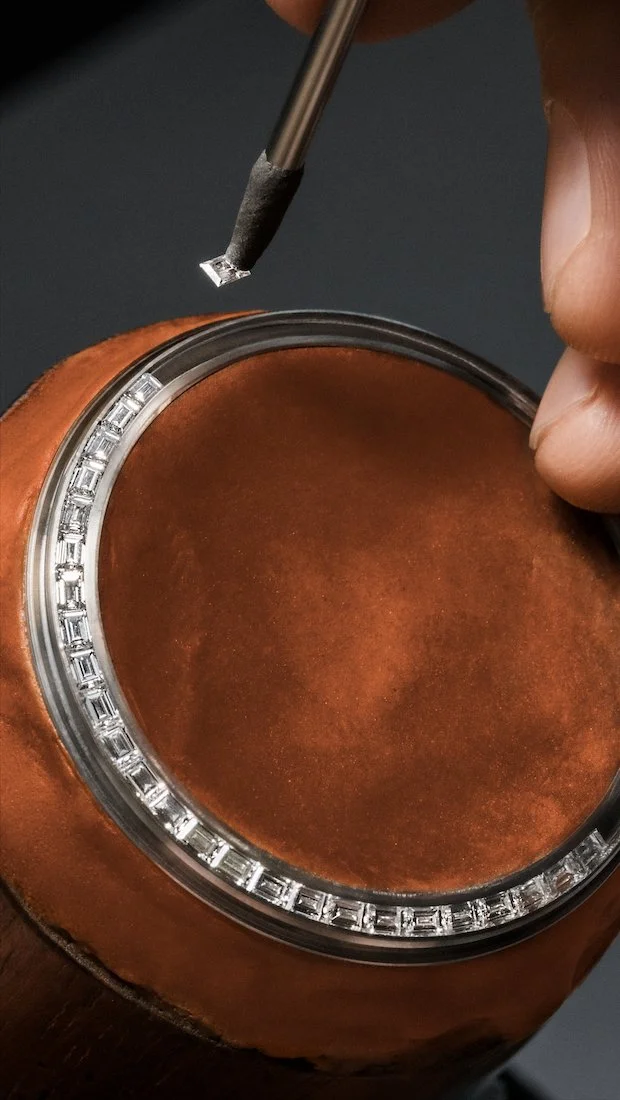
What elevates the Moon Dust beyond technical prowess is the harmonious integration of three artistic crafts: engraving, gem-setting, and guilloché work. The decoration evokes a planetary journey from Earth to the Moon, with hand-engraved sunrays breaking through clouds on one side and a view of the lunar surface on the other. The gem-setting alone required 230 hours of work, incorporating 200 baguette-cut diamonds (approximately 9 carats)—184 for the case and 16 for the clasp—and 165 brilliant-cut diamonds (approximately 0.92 carats) in nine different sizes also on the case. Snow setting creates an almost unbroken expanse of reflected light across the case middle and lugs, evoking the moon dust that inspired this watch's name.

The Indications: Front
The front dial features hand-guilloché work in a radiating pattern beneath blue PVD coating, creating visual depth that captures the immensity of space itself. The taille-douce engraving technique employed throughout creates incisions as shallow as 0.1 mm for clouds and as deep as 0.5 mm for planetary contours, with alternating polished and chased surfaces adding remarkable perspective.
Calendar and astronomical complications are featured on both sides of this double-sided masterpiece. The front dial opens with an aperture at 6 o'clock, revealing the hypnotic rotation of the tourbillon, while three counters display the perpetual calendar: date at 3 o'clock, day at 9 o'clock, and month at 12 o'clock. This perpetual calendar accounts for the complexities of the Gregorian calendar and requires no correction until 2100, a secular non-leap year. A small window at 1 o'clock displays the leap year indication, positioned beside a hand showing the minute repeater's power reserve. At 9 o'clock, a serpentine hand, mounted coaxially with the day indicator, tracks the movement's central power reserve, creating a visual echo with the chime's energy display.

The astronomical complications reveal the true sophistication of Calibre 2755 GC16. An equation of time gauge on the upper left edge of the dial addresses a fundamental astronomical reality: Earth's elliptical orbit and 23.4-degree axial tilt mean that solar noon varies throughout the year. The difference between true solar time and standardized civil time ranges from minus 16 to plus 14 minutes, coinciding only at the solstices and equinoxes. Flanking the tourbillon at 6 o'clock, sunrise and sunset indicators display the times for a reference city.

The Indications: Back
The reverse side presents an entirely different celestial perspective. Sidereal time—measured by Earth's rotation relative to distant stars rather than the Sun—is displayed through a fixed aperture revealing a rotating disc engraved with Northern Hemisphere constellations. A sidereal day lasts exactly 23 hours, 56 minutes, and 4 seconds, meaning Earth returns to its original stellar position roughly four minutes faster than a standard 24-hour day.
This constellation disc rotates with that four-minute acceleration, tracking sidereal time on a fixed, openworked dial graduated in 15-minute increments. The date appears on the rotating disc's periphery opposite the hour, while a large central hand indicates it again on the outer flange marked in five-day increments. This same hand points to the solstices and equinoxes, as well as the zodiac signs and seasons, marked on concentric circles. A smaller central hand tracks the moon's age—the days elapsed since the last new moon.

The Calibre 2755 GC16
At the heart of this masterpiece beats Calibre 2755 GC16, a manual-wound manufacture movement comprising 839 meticulously finished components. The tourbillon regulator, housed within a Maltese cross-shaped cage that completes one full rotation per minute, compensates for Earth's gravity while serving as the small seconds indicator. But Vacheron Constantin didn't stop there—they added a minute repeater controlled by an ingenious rotating regulator with two weights acting as a kind of "engine brake," producing sounds that are clear, distinct, and perfectly rhythmical.

The Grand Complication ‘Moon Dust’ features a minute repeater that chimes on demand, announcing hours, quarters, and minutes with mechanical precision. Vacheron Constantin equipped this complication with a sophisticated rotating regulator that manages the striking mechanism through an elegant solution: two precisely calibrated weights generate centripetal force to create what essentially functions as an acoustic "engine brake." This system operates in complete silence while controlling the duration of each musical sequence and moderating the energy flow from the barrel, resulting in sounds that are remarkably clear, distinct, and perfectly cadenced.

Beating at 18,000 vibrations per hour with a 58-hour power reserve, this manual-wound calibre resides in a 47 mm 18K white gold case specifically engineered to optimize the minute repeater's acoustic properties. The result is a remarkable feat of miniaturization that presents all functions with crystalline legibility across both sides.
Summary
The Les Cabinotiers Grand Complication High Jewellery ‘Moon Dust’ reference 9717C/000G-289C represents Vacheron Constantin at their most artistically ambitious and technically sophisticated. This Hallmark of Geneva certified timepiece isn't just a watch—it's a wearable testament to humanity's quest to understand and measure the cosmos. For the collector who appreciates grand complications enhanced by exceptional decorative arts, this single-piece edition stands as the ultimate expression of haute horlogerie's intersection with celestial poetry.
Sticker Price Upon Request. More info on Vacheron Constantin click here.