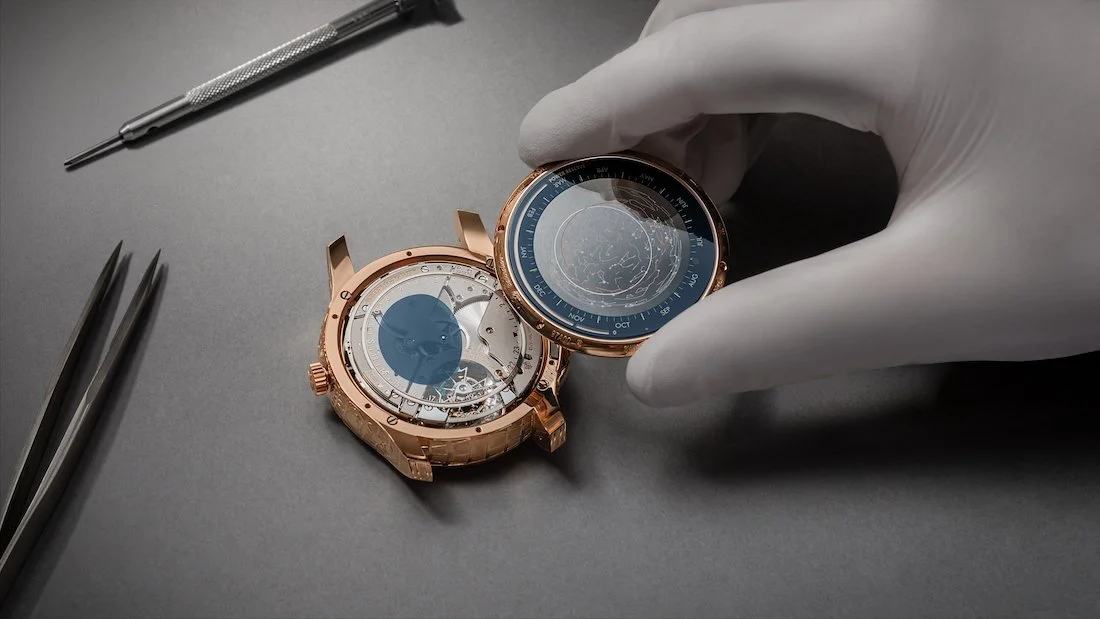
When Vacheron Constantin decided to honor the great astronomers who shaped humanity's understanding of the universe, they didn't create commemorative dials or symbolic engravings—they built two complete cosmological systems onto the wrist. Initially presented in 2017, the Les Cabinotiers Celestia Astronomical Grand Complication ref. 3600 Unique Piece took five years to develop, from scratch, along with two years of design by a dedicated master watchmaker at Vacheron Constantin. The Vacheron Constantin Celestia Astronomical Grand Complication includes 23 complications in a fully integrated movement composed of 514 parts and is the most accurate Equation of Time on the market.

Honoring the Greatest Astronomers
Now, two new interpretations of the Les Cabinotiers Celestia Astronomical Grand Complication are presented: Homage to Ptolemy and Homage to Copernicus, representing parallel universes of watchmaking. These two single-piece editions embody competing theories of celestial mechanics through 23 astronomical complications and 240 hours of hand-engraving per watch.
Housed in hand-engraved 45 mm x 13.91 mm cases—Homage to Copernicus in 18K 5N pink gold and Homage to Ptolemy in 18K white gold—with dark blue Mississippiensis alligator leather straps and matching hand-engraved folding clasps, these Hallmark of Geneva certified masterpieces represent Vacheron Constantin's astronomical watchmaking at its philosophical zenith. For the collector seeking horological cosmology, these competing visions of the universe offer not merely complications but complete mechanical interpretations of humanity's quest to understand the heavens.
Where these timepieces diverge dramatically is in their champlevé engraving. The ‘Homage to Ptolemy’ edition illustrates the geocentric system with hand-engraved planetary orbits circling Earth around the crown—a planisphere requiring extraordinary precision as ellipses extend across lugs and bezel without visual breaks.

The ‘Homage to Copernicus’ edition places the Sun at the crown, radiating rays while planets follow heliocentric orbits whose geometric centers fall outside the case frame, requiring custom compass tools to achieve perfect circular arcs on curved surfaces. Both feature hollows chiselled to depths between 0.1mm and 0.2mm, with planets subtly domed, textured, and polished to reproduce their cosmic appearance.

Both timepieces are powered by the extraordinary Calibre 3600, first presented in 2017 and requiring five years of development. This 36 mm diameter, 8.7mm thick manual-winding movement comprises 514 meticulously finished components and 64 jewels, beating at 18,000 vibrations per hour. The movement's remarkable achievement lies not just in housing 23 complications, but in its feat of miniaturization—packing this astronomical complexity into less than 9mm of thickness while delivering an exceptional three-week power reserve from six barrels mounted in series.


Two Visions of the Cosmos
The Celestia's defining characteristic is its display of three distinct times—civil, solar, and sidereal—each driven by its own gear train. The front dial displays civil and solar time through central openwork hands, with solar time indicated by a coaxial minute hand featuring a sun symbol. This running equation of time accounts for Earth's elliptical orbit and 23.5—degree axial tilt, creating variations from minus 16 to plus 14 minutes that coincide with civil time only at the solstices and equinoxes. A cam mechanically programs these predictable annual variations, allowing for the simultaneous reading of both time systems.
The front dial's grained 18K white gold—Homage to Ptolemy reference 97A0C/000G-304C—or 18K 5N pink gold—Homage to Copernicus reference 97A0C/000R-290C—backdrop displays seven additional complications with extraordinary sophistication. A perpetual calendar, programmed until 2100, displays days and months in windows at 1 o'clock, with leap years indicated above a date counter at 3 o'clock. The precision moon phase at 9 o'clock requires correction only once every 122 years, achieved through superimposed discs—a transparent upper disc with a laser-engraved moon and a shaded lower disc indicating day and night, with the moon's age readable around the edge.

Sunrise and sunset times are displayed on graduated scales in the dial's lower portion, flanking a gauge that shows day and night lengths. A rotating annual disc at 4 o'clock bears zodiac signs, seasons, solstices, and equinoxes. At 11 o'clock, a rare mareoscope complication combines a tidal level indicator with a three-dimensional representation of Earth-Moon-Sun alignment, precisely tracking the amplitude of tides at their highest during New Moon and Full Moon when all three bodies align.

The reverse side reveals sidereal time through two superimposed sapphire discs—a fixed upper disc marked with constellations and a rotating lower disc completing its cycle in 23 hours, 56 minutes, and 4 seconds, approximately four minutes faster than civil time. An off-center blue ellipse indicates which constellations are visible in real time from any given location, while white and red elliptical lines mark the celestial equator and ecliptic, respectively. A peripheral power reserve indicator and one-minute tourbillon housed in Vacheron Constantin's signature Maltese cross cage complete this celestial display.
Sticker Price Upon Request. More info on Vacheron Constantin, click here.